“You have a pair of pants. In the left pocket, you have $100. You take $1 out of the left pocket and put in the right pocket. You now have $101. There is no diminution of dollars in your left pocket. That is one magic pair of pants.”

Category: MP Market Reviews

MP Market Review – October 13, 2023

Last updated by BM on October 16, 2023

Summary 

  • This is a weekly installment of our MP Market Review series, which provides updates on the financial markets and Canadian dividend growth companies we monitor on ‘The List’.
  • Last week, ‘The List’ was down with a YTD price return of -1.1% (capital). Dividend growth is at +8.6% YTD, highlighting growth in income over the past year.
  • Last week, no dividend increases from companies on ‘The List’.
  • Last week, no earnings reports from companies on ‘The List’.
  • No companies on ‘The List’ are due to report earnings this week.
  • If you’re interested in creating your own dividend growth income portfolio, consider subscribing to our premium service, which grants you access to the MP Wealth-Builder Model Portfolio (CDN) and exclusive subscriber-only content.  Learn More         

Identifying companies whose dividend growth aligns closely with price growth can considerably enhance the predictability of future returns. Dividend growth investors know that the dividend drives the price in a predictable way, not the other way around. Fortis Inc. (FTS-T) is another company on ‘The List’ that aligns very closely with this dividend growth vs price growth pattern we like to see.

Introduction

“You have a pair of pants. In the left pocket, you have $100. You take $1 out of the left pocket and put it in the right pocket. You now have $101. There is no diminution of dollars in your left pocket. That is one magic pair of pants.”

This ‘magic pants’ analogy was from a Seeking Alpha article on dividend investing I read about a decade ago and was one of the catalysts for me to take a closer look at this type of investing and see if it truly was magical. 

After conducting additional research, I have shifted towards utilizing a dividend growth investing (DGI) strategy as my primary investment approach. While I maintain portfolios consisting of high-quality dividend growers from both the United States and Canada, I have opted to concentrate on Canadian (CDN) dividend growth companies in this blog. This is due to several reasons, including a smaller pool of DGI companies to track, a lack of coverage for the DGI strategy by the North American investment media, and a tendency for those who do cover DGI to narrowly focus on only a handful of sectors (Energy and Financials).

While ‘The List’ is not a portfolio in itself, it serves as an excellent initial reference for individuals seeking to diversify their investments and attain higher returns in the Canadian stock market. Through our blog, we provide weekly updates on ‘The List’ and offer valuable perspectives and real-life examples of the dividend growth investing strategy in practice. This helps readers gain a deeper understanding of how to implement and benefit from this investment approach.


DGI Thoughts

“It’s far better to buy a wonderful company at a fair price than a fair company at a wonderful price.”

– Warren Buffett

Quality vs Value

While we are always hunting for attractive investment opportunities, we must remember that the pursuit of bargains shouldn’t overshadow the importance of quality. This is a snapshot of ‘The List’ as of Friday, October 13, 2023, sorted by valuation according to the dividend yield theory (valuation measure).
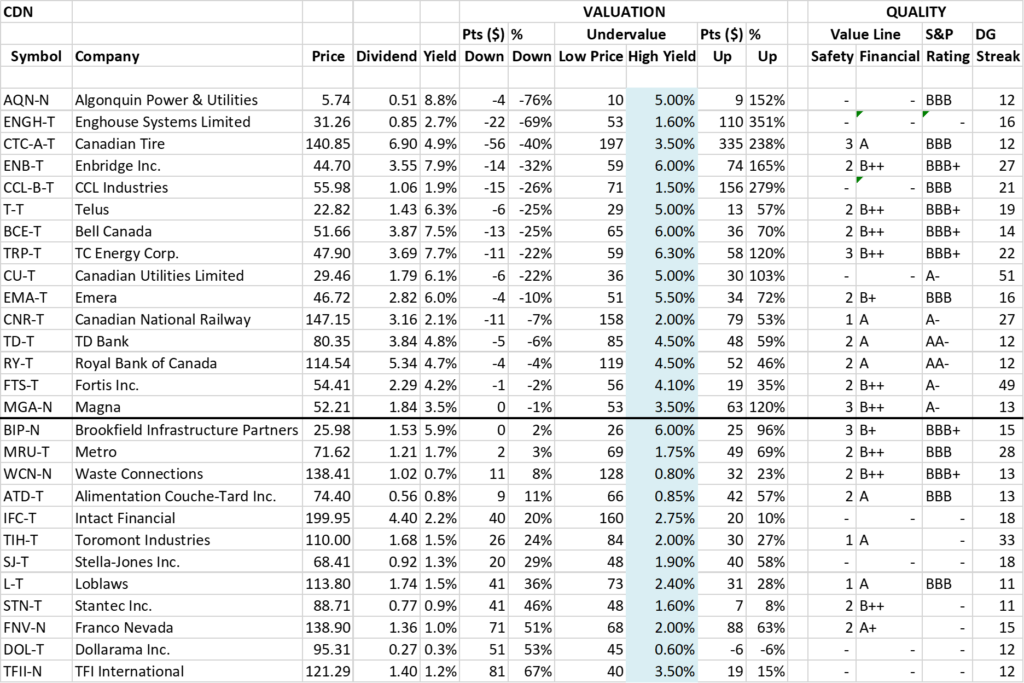
At present, half of ‘The List’ is deemed undervalued based on dividend yield theory. However, a different perspective emerges when we sort this list using some of our ‘quality indicators’ like Value Line Safety and Financial ratings, S&P Rating, and Dividend Growth Streak.
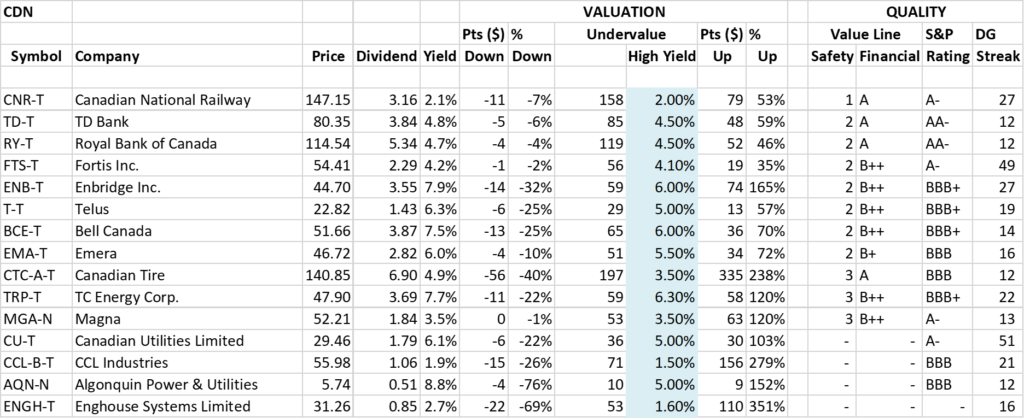
As Warren Buffett rightly advises, any investment strategy should prioritize acquiring companies positioned near the top of this list – those considered ‘wonderful companies’ – when they are reasonably priced. This approach, rather than focusing solely on valuation, promises a more favorable outcome.

If you have not yet joined as a paid subscriber of the blog to receive DGI Alerts on the activity and content related to our model portfolio, it’s not too late. Click Here. 

Recent News 

BMO strategist reiterates importance of a dividend growth portfolio in current environment (Globe & Mail)

https://www.theglobeandmail.com/investing/markets/inside-the-market/article-bmo-strategist-reiterates-importance-of-a-dividend-growth-portfolio-in/

“BMO chief investment strategist Brian Belski reiterated his belief that dividend growth is the correct strategy for income-oriented investors.”

The author discusses the limitations of ‘yield-focused strategies’ in this article. For many investors, the key distinction lies in separating high-yield dividend investing from investing in quality dividend growth companies that consistently increase their cash flow each year. It is not the initial high yield that wins; rather, it is the combination of yield plus growth over time.

I would argue that dividend growth investing is important in any environment but then again, I am a little biased.

The carnage in dividend-land is an epic buying opportunity, if you have time to wait (Globe & Mail)

https://www.theglobeandmail.com/investing/personal-finance/carrick-on-money/article-the-carnage-in-dividend-land-is-an-epic-buying-opportunity-if-you-have/

“Prices will rise, yields will come down. Investors who bought dividend stocks when they were beaten down will be rewarded in three ways:

  1. Potential price rebounds: Some blue-chip dividend stocks have fallen so hard lately that their share prices are down or flat over the past five years.
  2. Dividend growth: Bond interest is locked in, but many dividend stocks have a history of annual dividend increases.
  3. Tax: In a non-registered account, the dividend tax credit means you pay less tax on dividends from a corporation than you do on bond interest.”

I’m pleased to see a growing number of articles about dividend growth investing in the financial media. When traditional index and growth-focused approaches no longer deliver the desired results, you can always rely on the time-tested strategy of dividend growth investing.

The List (2023)

Last updated by BM on October 13, 2023

The Magic Pants List contains 27 Canadian dividend growth stocks. ‘The List’ contains Canadian companies that have raised their dividend yearly for at least the last ten years and have a market cap of over a billion dollars. Below is each stock’s symbol, name, current yield, current price, price return year-to-date, current dividend, dividend growth year-to-date and current dividend growth streak. Companies on ‘The List’ are added or subtracted once a year, on January 1. After that, ‘The List’ is set for the next twelve months. Prices and dividends are updated weekly.

SYMBOL COMPANY YLD PRICE YTD % DIV YTD % STREAK
AQN-N Algonquin Power & Utilities 8.8% $5.74 -14.7% $0.51 -29.0% 12
ATD-T Alimentation Couche-Tard Inc. 0.8% $74.40 23.7% $0.56 19.1% 13
BCE-T Bell Canada 7.5% $51.66 -14.2% $3.87 5.2% 14
BIP-N Brookfield Infrastructure Partners 4.4% $25.98 -17.7% $1.44 6.3% 15
CCL-B-T CCL Industries 1.9% $55.98 -3.6% $1.06 10.4% 21
CNR-T Canadian National Railway 2.1% $147.15 -9.7% $3.16 7.8% 27
CTC-A-T Canadian Tire 4.9% $140.85 -3.9% $6.90 17.9% 12
CU-T Canadian Utilities Limited 6.1% $29.46 -20.2% $1.79 1.0% 51
DOL-T Dollarama Inc. 0.3% $95.31 19.3% $0.27 23.8% 12
EMA-T Emera 6.0% $46.72 -11.2% $2.82 5.0% 16
ENB-T Enbridge Inc. 7.9% $44.70 -16.2% $3.55 3.2% 27
ENGH-T Enghouse Systems Limited 2.7% $31.26 -12.5% $0.85 18.2% 16
FNV-N Franco Nevada 1.0% $138.90 0.5% $1.36 6.3% 15
FTS-T Fortis Inc. 4.2% $54.41 -1.7% $2.29 5.3% 49
IFC-T Intact Financial 2.2% $199.95 2.1% $4.40 10.0% 18
L-T Loblaws 1.5% $113.80 -5.4% $1.74 13.2% 11
MGA-N Magna 3.5% $52.21 -9.2% $1.84 2.2% 13
MRU-T Metro 1.7% $71.62 -5.1% $1.21 10.0% 28
RY-T Royal Bank of Canada 4.7% $114.54 -10.5% $5.34 7.7% 12
SJ-T Stella-Jones Inc. 1.3% $68.41 38.0% $0.92 15.0% 18
STN-T Stantec Inc. 0.9% $88.71 35.8% $0.77 8.5% 11
TD-T TD Bank 4.8% $80.35 -8.3% $3.84 7.9% 12
TFII-N TFI International 1.2% $121.29 21.1% $1.40 29.6% 12
TIH-T Toromont Industries 1.5% $110.00 12.6% $1.68 10.5% 33
TRP-T TC Energy Corp. 7.7% $47.90 -10.1% $3.69 3.4% 22
T-T Telus Corp. 6.3% $22.82 -13.3% $1.43 7.4% 19
WCN-N Waste Connections 0.7% $138.41 5.1% $1.02 7.4% 13
Averages 3.6% -1.1% 8.6% 19

Six Canadian stocks on ‘The List’ declare earnings and dividends in US dollars and are inter-listed on a US exchange in US dollars. The simplest way to display dividend and price metrics for these stocks is to show their US exchange symbols along with their US dividends and price. The stocks I am referring to have a -N at the end of their symbols. You can still buy their Canadian counterparts (-T), but your dividends will be converted into CDN dollars and will fluctuate based on the exchange rate.

Note: When the dividend and share price currency match, the calculation is straightforward. But it’s not so simple when the dividend is declared in one currency, and the share price is quoted in another. Dividing the former by the latter would produce a meaningless result because it’s a case of apples and oranges. To calculate the yield properly, you must express the dividend and share price in the same currency.

Performance of ‘The List’

Feel free to click on this link, ‘The List’ for a sortable version from our website.

Last week, ‘The List’ was down with a YTD price return of -1.1% (capital). Dividend growth is now at +8.6% YTD, highlighting growth in income over the past year.

The best performers last week on ‘The List’ were Stella-Jones Inc. (SJ-T), up +5.80%; Franco Nevada (FNV-N), up +5.11%; and TC Energy Corp. (TRP-T), up +4.75%.

Brookfield Infrastructure Partners (BIP-N) was the worst performer again last week, down -7.31%.


Dividend Increases

“The growth of dividend paying ability is of significance in the determination of a stock’s quality, or general safety…”

– Arnold Bernhard (the founder of Value Line)

“As a dividend increase is a positive sign of a company’s financial strength, the safest purchase, after research, is a stock with a recent dividend increase.”

– Tom Connolly (the founder of dividendgrowth.ca)

Last week, no dividend increases from companies on ‘The List’.


Earnings Releases

Benjamin Graham once remarked that earnings are the principal factor driving stock prices.

Each quarter we will provide readers with weekly earnings updates of stocks on ‘The List’ during the calendar earnings season. 

The updated earnings calendar can be found here.

Earnings growth and dividend growth tend to go hand in hand, so this information can tell us a lot about the future dividend growth of our quality companies. Monitoring our dividend growers periodically is part of the process, and reading the quarterly earnings releases is a good place to start.

No earnings reports from companies on ‘The List’ this week

Last week, no companies on ‘The List’ reported earnings.
 

MP Market Review – October 06, 2023

Last updated by BM on October 09, 2023

Summary 

  • This is a weekly installment of our MP Market Review series, which provides updates on the financial markets and Canadian dividend growth companies we monitor on ‘The List’.
  • Last week, ‘The List’ was down with a YTD price return of -0.9% (capital). Dividend growth remained the same at +8.5% YTD, highlighting growth in income over the past year.
  • Last week, no dividend increases from companies on ‘The List’.
  • Last week, no earnings reports from companies on ‘The List’.
  • No companies on ‘The List’ are due to report earnings this week.
  • If you’re interested in creating your own dividend growth income portfolio, consider subscribing to our premium service, which grants you access to the MP Wealth-Builder Model Portfolio (CDN) and exclusive subscriber-only content.  Learn More         

Identifying companies whose dividend growth aligns closely with price growth can considerably enhance the predictability of future returns. Dividend growth investors know that the dividend drives the price in a predictable way, not the other way around. Fortis Inc. (FTS-T) is another company on ‘The List’ that aligns very closely with this dividend growth vs price growth pattern we like to see.

Introduction

“You have a pair of pants. In the left pocket, you have $100. You take $1 out of the left pocket and put it in the right pocket. You now have $101. There is no diminution of dollars in your left pocket. That is one magic pair of pants.”

This ‘magic pants’ analogy was from a Seeking Alpha article on dividend investing I read about a decade ago and was one of the catalysts for me to take a closer look at this type of investing and see if it truly was magical. 

After conducting additional research, I have shifted towards utilizing a dividend growth investing (DGI) strategy as my primary investment approach. While I maintain portfolios consisting of high-quality dividend growers from both the United States and Canada, I have opted to concentrate on Canadian (CDN) dividend growth companies in this blog. This is due to several reasons, including a smaller pool of DGI companies to track, a lack of coverage for the DGI strategy by the North American investment media, and a tendency for those who do cover DGI to narrowly focus on only a handful of sectors (Energy and Financials).

While ‘The List’ is not a portfolio in itself, it serves as an excellent initial reference for individuals seeking to diversify their investments and attain higher returns in the Canadian stock market. Through our blog, we provide weekly updates on ‘The List’ and offer valuable perspectives and real-life examples of the dividend growth investing strategy in practice. This helps readers gain a deeper understanding of how to implement and benefit from this investment approach.


DGI Thoughts

“Stock returns always add up to the sum of the current dividend yield, plus dividends/earnings per share growth, plus or minus any change in the valuation”.

– Charles Ellis

‘Higher for longer’

Rising interest rates can have a detrimental impact on stocks for two primary reasons. Firstly, interest expenses play a crucial role in a company’s income statement. If the cost of borrowing money increases, companies tend to borrow less and face higher expenses when refinancing existing debt. Secondly, higher yields present more attractive alternatives for investors’ capital, creating stronger competition for their investments.

With recent data still indicating an overheated economy (inflation accelerating), Central Banks may find themselves with no choice but to raise interest rates further or, at the very least, maintain their current trajectory.

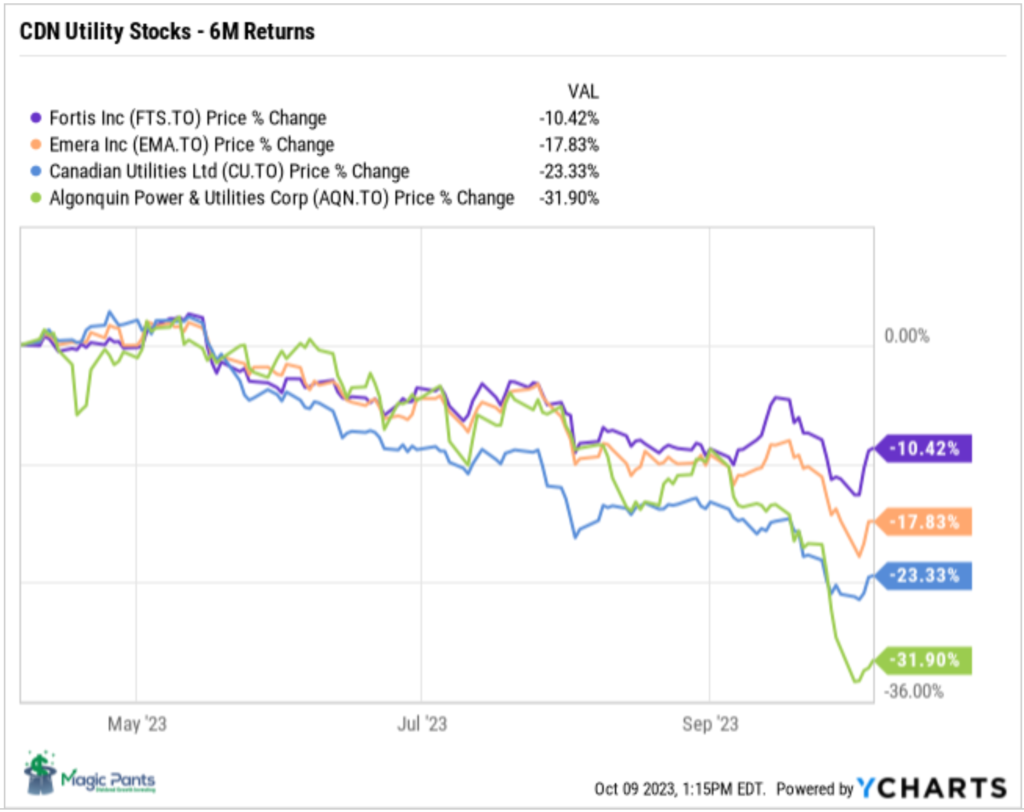
Let’s delve deeper into the implications of the increasingly prevalent “higher for longer” narrative within the investment media. Capital-intensive business models, such as pipelines, telecommunications companies (Telcos), Real Estate Investment Trusts (REITs), and utilities, could experience adverse effects if interest rates remain elevated for an extended period. Even the most defensively positioned sector among them, utilities, is not immune to these impacts.

Utility companies are often considered defensive stocks for several reasons:

  1. Steady Demand: Utility services, such as electricity, natural gas, water, and telecommunications, are necessities for both individuals and businesses. Regardless of economic conditions, people continue to use these services. This steady demand provides a reliable source of revenue for utility companies.
  1. Stable Cash Flows: Utility companies typically have a regulated business model. Regulatory bodies often set the rates these companies can charge for their services, which can provide a degree of predictability and stability to their cash flows. This regulation helps ensure that utility companies can cover their operating costs and debt obligations even during economic downturns.
  1. Income Generation: Many investors, especially those seeking income or dividends, are attracted to utility stocks because they tend to offer relatively high dividend yields. Utility companies often distribute a significant portion of their profits to shareholders in the form of dividends. This income can be especially appealing during periods of economic uncertainty when other investment options may offer lower yields or more risk.
  1. Low Price Elasticity: The demand for utility services is relatively price inelastic, meaning that changes in the price of these services do not significantly impact demand. People continue to use electricity, gas, and water even if prices increase moderately. This price inelasticity can help protect utility companies from severe revenue declines during economic downturns.
  1. Defensive Nature: Utility stocks are often considered “defensive” in the sense that they tend to be less sensitive to economic cycles. When the economy is performing poorly, investors may flock to defensive stocks like utilities as a way to preserve capital and maintain income.
  1. Hedging Against Market Volatility: Utility stocks can act as a hedge against market volatility. During periods of stock market turbulence, investors may seek refuge in assets that are less affected by market fluctuations. Utility stocks, with their stable cash flows and dividends, can provide a level of stability to a diversified investment portfolio.
  1. Regulated Monopolies: In many cases, utility companies operate as regulated monopolies in specific regions. This means they have limited competition, allowing them to maintain more consistent pricing power and profitability.

With characteristics like these, it’s no surprise that utility companies appear on ‘The List’ and have consistently delivered increasing income and capital appreciation to dividend growth investors for decades. Recent stock market data, however, paints a different picture of their defensive nature.

High interest rates, particularly the current narrative of “higher for longer” interest rates, have had a negative impact on utility companies, for the reasons explained earlier. To succeed, we must identify the highest quality utility companies and increase our holdings when they are oversold and trading at a discount to their fair value (sensible price). High interest rates are not sustainable over the long term and our good dividend growers will eventually rebound. In the short term there will still be yield and growth in a market sell-off.

If you have not yet joined as a paid subscriber of the blog to receive DGI Alerts on the activity and content related to our model portfolio, it’s not too late. Click Here. 

Recent News 

Dividend stocks may be sinking, but my cash flow keeps growing (Globe & Mail)

https://www.theglobeandmail.com/investing/education/article-dividend-stocks-may-be-sinking-but-my-cash-flow-keeps-growing/

“For the first several years, the model portfolio chugged along nicely. Companies raised their dividends regularly, and their share prices moved steadily higher, too.”

DGI Truth #2: A rising dividend income stream will eventually lead to rising stock prices.

I have been following Mr. Heinzl’s articles for several years now and have commented on the reasons why his ‘Yield Hog Dividend Growth Portfolio’ has underperformed our portfolios in the past. While he includes some of our quality companies, he also incorporates REITs and ETFs for diversification. With rising interest rates, he is finally feeling the impact of his decision to include cyclical and lower-quality companies in his portfolio.

“But the benefits of rising dividends are more than financial. When your investment income is growing steadily, it’s easier to accept market volatility and sliding stock prices as normal parts of investing without panicking and doing something rash.” 

Although the author seems to grasp many of our dividend growth investing principles, a greater emphasis on quality would have helped avoid many of his ‘surprises’ over the years.

A tough year for dividend stocks puts lots of big names on sale (Globe & Mail)

https://www.theglobeandmail.com/investing/markets/inside-the-market/article-a-tough-year-for-dividend-stocks-puts-lots-of-big-names-on-sale/

“But dividend stocks have a couple of advantages when it comes to inflation, Mr. Bushell said. The first is the potential for dividend increases. And the second is that many businesses can pass on some inflation through pricing power.”

DGI Truth #3: Dividend growth investors enjoy inflation-protected income.

Amidst the ongoing discussions regarding the potential for interest rates to remain ‘higher for longer,’ investors seeking greater yields may consider Guaranteed Investment Certificates (GICs) or High-Interest Savings Accounts as more secure options for their funds. However, what they often fail to recognize is that even within these seemingly risk-free investments, their cash remains susceptible to the erosive impact of inflation, resulting in a negative real rate of return. To put it simply, their purchasing power may dwindle over time, despite the appearance of security in their investments.

While we cannot completely shield our capital from price volatility in the short term, we can minimize the impact of inflation on our purchasing power through our income (rising dividends). Thus far, our dividend increases have consistently outpaced the rate of inflation.

The List (2023)

Last updated by BM on October 06, 2023

The Magic Pants List contains 27 Canadian dividend growth stocks. ‘The List’ contains Canadian companies that have raised their dividend yearly for at least the last ten years and have a market cap of over a billion dollars. Below is each stock’s symbol, name, current yield, current price, price return year-to-date, current dividend, dividend growth year-to-date and current dividend growth streak. Companies on ‘The List’ are added or subtracted once a year, on January 1. After that, ‘The List’ is set for the next twelve months. Prices and dividends are updated weekly.

SYMBOL COMPANY YLD PRICE YTD % DIV YTD % STREAK
AQN-N Algonquin Power & Utilities 8.8% $5.77 -14.3% $0.51 -29.0% 12
ATD-T Alimentation Couche-Tard Inc. 0.8% $71.87 19.5% $0.56 19.1% 13
BCE-T Bell Canada 7.6% $51.02 -15.3% $3.87 5.2% 14
BIP-N Brookfield Infrastructure Partners 4.4% $28.03 5.2% $1.44 6.3% 15
CCL-B-T CCL Industries 1.9% $56.26 -3.1% $1.06 10.4% 21
CNR-T Canadian National Railway 2.2% $146.35 -10.1% $3.16 7.8% 27
CTC-A-T Canadian Tire 4.9% $141.56 -3.4% $6.90 17.9% 12
CU-T Canadian Utilities Limited 6.1% $29.42 -20.4% $1.79 1.0% 51
DOL-T Dollarama Inc. 0.3% $94.15 17.9% $0.27 23.8% 12
EMA-T Emera 5.9% $47.39 -9.9% $2.82 5.0% 16
ENB-T Enbridge Inc. 8.2% $43.47 -18.5% $3.55 3.2% 27
ENGH-T Enghouse Systems Limited 2.7% $31.07 -13.0% $0.85 18.2% 16
FNV-N Franco Nevada 1.0% $132.15 -4.3% $1.36 6.3% 15
FTS-T Fortis Inc. 4.3% $53.45 -3.4% $2.29 5.3% 49
IFC-T Intact Financial 2.2% $199.09 1.7% $4.40 10.0% 18
L-T Loblaws 1.5% $116.46 -3.2% $1.74 10.3% 11
MGA-N Magna 3.4% $54.18 -5.8% $1.84 2.2% 13
MRU-T Metro 1.7% $71.51 -5.3% $1.21 10.0% 28
RY-T Royal Bank of Canada 4.6% $114.90 -10.3% $5.34 7.7% 12
SJ-T Stella-Jones Inc. 1.4% $64.66 30.4% $0.92 15.0% 18
STN-T Stantec Inc. 0.9% $89.88 37.6% $0.77 8.5% 11
TD-T TD Bank 4.8% $79.80 -9.0% $3.84 7.9% 12
TFII-N TFI International 1.1% $124.78 24.6% $1.40 29.6% 12
TIH-T Toromont Industries 1.5% $110.49 13.1% $1.68 10.5% 33
TRP-T TC Energy Corp. 8.1% $45.73 -14.2% $3.69 3.4% 22
T-T Telus Corp. 6.3% $22.55 -14.3% $1.43 7.4% 19
WCN-N Waste Connections 0.8% $135.96 3.2% $1.02 7.4% 13
Averages 3.6% -0.9% 8.5% 19

Six Canadian stocks on ‘The List’ declare earnings and dividends in US dollars and are inter-listed on a US exchange in US dollars. The simplest way to display dividend and price metrics for these stocks is to show their US exchange symbols along with their US dividends and price. The stocks I am referring to have a -N at the end of their symbols. You can still buy their Canadian counterparts (-T), but your dividends will be converted into CDN dollars and will fluctuate based on the exchange rate.

Note: When the dividend and share price currency match, the calculation is straightforward. But it’s not so simple when the dividend is declared in one currency, and the share price is quoted in another. Dividing the former by the latter would produce a meaningless result because it’s a case of apples and oranges. To calculate the yield properly, you must express the dividend and share price in the same currency.

Performance of ‘The List’

Feel free to click on this link, ‘The List’ for a sortable version from our website.

Last week, ‘The List’ was down with a YTD price return of -0.9% (capital). Dividend growth remained the same at +8.5% YTD, highlighting growth in income over the past year.

The best performers last week on ‘The List’ were Alimentation Couche-Tard Inc. (ATD-T), up +4.19%; Enghouse Systems Limited (ENGH-T), up +3.64%; and Fortis Inc. (FTS-T), up +3.61%.

Brookfield Infrastructure Partners (BIP-N) was the worst performer last week, down -4.66%.


Dividend Increases

“The growth of dividend paying ability is of significance in the determination of a stock’s quality, or general safety…”

– Arnold Bernhard (the founder of Value Line)

“As a dividend increase is a positive sign of a company’s financial strength, the safest purchase, after research, is a stock with a recent dividend increase.”

– Tom Connolly (the founder of dividendgrowth.ca)

Last week, no dividend increases from companies on ‘The List’.


Earnings Releases

Benjamin Graham once remarked that earnings are the principal factor driving stock prices.

Each quarter we will provide readers with weekly earnings updates of stocks on ‘The List’ during the calendar earnings season. 

The updated earnings calendar can be found here.

Earnings growth and dividend growth tend to go hand in hand, so this information can tell us a lot about the future dividend growth of our quality companies. Monitoring our dividend growers periodically is part of the process, and reading the quarterly earnings releases is a good place to start.

No earnings reports from companies on ‘The List’ this week

Last week, no companies on ‘The List’ reported earnings.


MP Market Review – September 29, 2023

Last updated by BM on October 02, 2023

Summary 

  • This is a weekly installment of our MP Market Review series, which provides updates on the financial markets and Canadian dividend growth companies we monitor on ‘The List’.
  • Last week, ‘The List’ was down with a YTD price return of -0.8% (capital). Dividend growth remained the same at +8.5% YTD, highlighting growth in income over the past year.
  • Last week, no dividend increases from companies on ‘The List’.
  • Last week, no earnings report from companies on ‘The List’.
  • No companies on ‘The List’ are due to report earnings this week.
  • If you’re interested in creating your own dividend growth income portfolio, consider subscribing to our premium service, which grants you access to the MP Wealth-Builder Model Portfolio (CDN) and exclusive subscriber-only content.  Learn More         

Identifying companies whose dividend growth aligns closely with price growth can considerably enhance the predictability of future returns. Dividend growth investors know that the dividend drives the price in a predictable way, not the other way around. Fortis Inc. (FTS-T) is another company on ‘The List’ that aligns very closely with this dividend growth vs price growth pattern we like to see.

Introduction

“You have a pair of pants. In the left pocket, you have $100. You take $1 out of the left pocket and put it in the right pocket. You now have $101. There is no diminution of dollars in your left pocket. That is one magic pair of pants.”

This ‘magic pants’ analogy was from a Seeking Alpha article on dividend investing I read about a decade ago and was one of the catalysts for me to take a closer look at this type of investing and see if it truly was magical. 

After conducting additional research, I have shifted towards utilizing a dividend growth investing (DGI) strategy as my primary investment approach. While I maintain portfolios consisting of high-quality dividend growers from both the United States and Canada, I have opted to concentrate on Canadian (CDN) dividend growth companies in this blog. This is due to several reasons, including a smaller pool of DGI companies to track, a lack of coverage for the DGI strategy by the North American investment media, and a tendency for those who do cover DGI to narrowly focus on only a handful of sectors (Energy and Financials).

While ‘The List’ is not a portfolio in itself, it serves as an excellent initial reference for individuals seeking to diversify their investments and attain higher returns in the Canadian stock market. Through our blog, we provide weekly updates on ‘The List’ and offer valuable perspectives and real-life examples of the dividend growth investing strategy in practice. This helps readers gain a deeper understanding of how to implement and benefit from this investment approach.


DGI Thoughts

“If you are not going to sell a stock, what happens to its price is a matter of indifference. For true long-term investors – that small group of people like Warren Buffett who can shut their eyes to short-term fluctuations and have no doubt that what goes down will come back up – volatility represents opportunity rather than risk.”

–  Peter L. Bernstein, Against the Gods, page 261

One of my mentors, Tom Connolly, published a report back in 2018 that I revisit and review when the market experiences a significant downturn with no clear end in sight. I believe now is a good time to share some of his insights with our readers.

Why dividend growth investors do not worry in a market sell off.

  • What really matters is the rising future stream of dividends and retained earnings. Eventually, there will also be a commensurate rise in the capital value of the stock.
  • In a market sell-off, it’s the excitement factor/transient return (p/e) that drops. Dividends, intrinsic values, retained earnings actually continue to grow in a bear market. This is the ultimate solid foundation under our dividend growth strategy.
  • “In violent market sell-offs even solid names get treated as ‘lemons’, initially”. M. El-Erain. Take advantage of this shoddy thinking.
  • Shut your eyes to short term fluctuations: we do not buy to sell. The market is a mind game. Be disciplined. Hold for the cash flow. Think very long term.
  • Volatility is not risk!
  • Yield on Cost – If market gyrations bother you, study the yield on the original price of stocks you purchased years ago. Such data is relaxing.
  • Market price can be volatile: intrinsic value and dividends do not fluctuate much.
  • We own companies that have increased dividends each year for years. Quality!
  • Study year-over-year dividend data for a decade. Market bleeps are hardly there.
  • Charles Ellis – “Stock returns always add up to the sum of the current dividend yield, plus dividends/earnings per share growth, plus or minus any change in the valuation”. There will still be yield and growth in a market sell-off. p.130
  • Peter L. Bernstein – “If you are not going to sell a stock, what happens to its price is a matter of indifference. For true long-term investors – that small group of people like Warren Buffett who can shut their eyes to short-term fluctuations and have no doubt that what goes down will come back up – volatility represents opportunity rather than risk.” Peter L. Bernstein, Against the Gods, page 261
  • James Montier – “In the long-run, the return is almost exclusively driven by dividends”
  • Steven Jarislowsky – “If you have premium high compound growth noncyclicals, it is not really necessary to get out if the stock price goes too high. If far too high, obviously you can trim a bit and pay some tax, but be sure your gains have been real, not inflation mirages. Personally, I normally just hold and take a few down drafts, counting on the next bull market to take me up again.”
  • Dimson, Marsh and Staunton “the vast majority of long-term real returns are derived from equity income”.
  • Ben Graham – “Basically, price fluctuations have only one significant meaning for the true investor. They provide an opportunity to buy wisely when prices fall sharply and to sell wisely when they advance a great deal. At other times he will do better if he forgets about the stock market and pays attention to his dividend returns and to the operating results of his companies.” Intelligent Investor C-8
  • Warren Buffett – Feb 24, 2018 “undistributed earnings…will, over time. Translate into commensurate capital gains. Quality. Always and only quality companies.
  • Jack Bogle – “the stock market is a giant distraction from the business of investing”

If you have not yet joined as a paid subscriber of the blog to receive DGI Alerts on the activity and content related to our model portfolio, it’s not too late. Click Here. 

Recent News 

Dividend-paying stocks will be far more important than in the past (Globe & Mail)

https://www.theglobeandmail.com/investing/investment-ideas/article-dividend-paying-stocks-will-be-far-more-important-than-in-the-past/

A few of my favourite quotes from the article:

“A US$10,000 investment in 1960 in the S&P 500 would be worth more than US$4-million now, with more than 80 per cent of that gain from dividends (assuming reinvestment) and 20 per cent from capital gains.”

“Dividend stocks are attractive, but not all are the same. The most attractive firms are in good businesses with great management that can consistently increase dividends.”

There is no point in buying stocks that pay dividends if you are going to give up a portion of your cash flows by paying large fees to active managers, most of whom, if you believe the empirical evidence, do not add any value over the long run.”

Build your own dividend growth portfolio with quality companies that have a track record of dividend growth by subscribing today. We will show you how!

I’m buying Fortis while this dividend growth darling is still cheap (Globe & Mail)

https://www.theglobeandmail.com/investing/education/article-im-buying-fortis-while-this-dividend-growth-darling-is-still-cheap/

“… when it comes to investing, there is one thing that’s virtually certain: Shareholders of Fortis Inc. will get a dividend increase every year.”

Utility stocks, such as Fortis Inc., tend to be sensitive to changes in interest rates. When interest rates are low, the dividend offered by these stocks becomes more attractive to investors. Currently, investors are finding higher rates in alternative investments, which is putting pressure on the stock price. Like the author’s perspective, we also anticipate a buying opportunity for this high-quality dividend growth stock in the near future.

The List (2023)

Last updated by BM on September 29, 2023

The Magic Pants List contains 27 Canadian dividend growth stocks. ‘The List’ contains Canadian companies that have raised their dividend yearly for at least the last ten years and have a market cap of over a billion dollars. Below is each stock’s symbol, name, current yield, current price, price return year-to-date, current dividend, dividend growth year-to-date and current dividend growth streak. Companies on ‘The List’ are added or subtracted once a year, on January 1. After that, ‘The List’ is set for the next twelve months. Prices and dividends are updated weekly.

SYMBOL COMPANY YLD PRICE YTD % DIV YTD % STREAK
AQN-N Algonquin Power & Utilities 8.6% $5.92 -12.0% $0.51 -29.0% 12
ATD-T Alimentation Couche-Tard Inc. 0.8% $68.98 14.7% $0.56 19.1% 13
BCE-T Bell Canada 7.4% $51.85 -13.9% $3.82 5.0% 14
BIP-N Brookfield Infrastructure Partners 4.4% $29.40 5.2% $1.44 6.3% 15
CCL-B-T CCL Industries 1.9% $57.01 -1.8% $1.06 10.4% 21
CNR-T Canadian National Railway 2.1% $147.09 -9.7% $3.16 7.8% 27
CTC-A-T Canadian Tire 4.7% $146.05 -0.4% $6.90 17.9% 12
CU-T Canadian Utilities Limited 6.3% $28.70 -22.3% $1.79 1.0% 51
DOL-T Dollarama Inc. 0.3% $93.58 17.2% $0.27 23.8% 12
EMA-T Emera 5.8% $47.42 -9.9% $2.76 3.0% 16
ENB-T Enbridge Inc. 7.9% $45.05 -15.5% $3.55 3.2% 27
ENGH-T Enghouse Systems Limited 2.8% $29.98 -16.0% $0.85 18.2% 16
FNV-N Franco Nevada 1.0% $133.49 -3.4% $1.36 6.3% 15
FTS-T Fortis Inc. 4.4% $51.59 -6.8% $2.29 5.3% 49
IFC-T Intact Financial 2.2% $198.02 1.1% $4.40 10.0% 18
L-T Loblaws 1.5% $115.40 -4.1% $1.74 10.3% 11
MGA-N Magna 3.4% $53.61 -6.8% $1.84 2.2% 13
MRU-T Metro 1.7% $70.54 -6.5% $1.21 10.0% 28
RY-T Royal Bank of Canada 4.5% $118.70 -7.3% $5.34 7.7% 12
SJ-T Stella-Jones Inc. 1.4% $65.32 31.7% $0.92 15.0% 18
STN-T Stantec Inc. 0.9% $88.13 34.9% $0.77 8.5% 11
TD-T TD Bank 4.7% $81.83 -6.7% $3.84 7.9% 12
TFII-N TFI International 1.1% $128.41 28.2% $1.40 29.6% 12
TIH-T Toromont Industries 1.5% $110.62 13.2% $1.68 10.5% 33
TRP-T TC Energy Corp. 7.9% $46.71 -12.4% $3.69 3.4% 22
T-T Telus Corp. 6.4% $22.18 -15.7% $1.43 7.4% 19
WCN-N Waste Connections 0.8% $134.30 2.0% $1.02 7.4% 13
Averages 3.6% -0.8% 8.5% 19

Six Canadian stocks on ‘The List’ declare earnings and dividends in US dollars and are inter-listed on a US exchange in US dollars. The simplest way to display dividend and price metrics for these stocks is to show their US exchange symbols along with their US dividends and price. The stocks I am referring to have a -N at the end of their symbols. You can still buy their Canadian counterparts (-T), but your dividends will be converted into CDN dollars and will fluctuate based on the exchange rate.

Note: When the dividend and share price currency match, the calculation is straightforward. But it’s not so simple when the dividend is declared in one currency, and the share price is quoted in another. Dividing the former by the latter would produce a meaningless result because it’s a case of apples and oranges. To calculate the yield properly, you must express the dividend and share price in the same currency.

Performance of ‘The List’

Feel free to click on this link, ‘The List’ for a sortable version from our website.

Last week, ‘The List’ was down with a YTD price return of -0.8% (capital). Dividend growth remained the same at +8.5% YTD, highlighting growth in income over the past year.

The best performers last week on ‘The List’ were Loblaws (L-T), up +2.08%; Stella-Jones Inc. (SJ-T), up +1.57%; and Enghouse Systems Limited (ENGH-T), up +0.64%.

Algonquin Power & Utilities (AQN-N) was the worst performer last week, down -13.83%.


Dividend Increases

“The growth of dividend paying ability is of significance in the determination of a stock’s quality, or general safety…”

– Arnold Bernhard (the founder of Value Line)

“As a dividend increase is a positive sign of a company’s financial strength, the safest purchase, after research, is a stock with a recent dividend increase.”

– Tom Connolly (the founder of dividendgrowth.ca)

Last week, no dividend increases from companies on ‘The List’.


Earnings Releases

Benjamin Graham once remarked that earnings are the principal factor driving stock prices.

Each quarter we will provide readers with weekly earnings updates of stocks on ‘The List’ during the calendar earnings season. 

The updated earnings calendar can be found here.

Earnings growth and dividend growth tend to go hand in hand, so this information can tell us a lot about the future dividend growth of our quality companies. Monitoring our dividend growers periodically is part of the process, and reading the quarterly earnings releases is a good place to start.

No earnings reports from companies on ‘The List’ this week

Last week, no companies on ‘The List’ reported earnings.
 

MP Market Review – September 22, 2023

Last updated by BM on September 25, 2023

Summary 

  • This is a weekly installment of our MP Market Review series, which provides updates on the financial markets and Canadian dividend growth companies we monitor on ‘The List’.
  • Last week, ‘The List’ was up with a YTD price return of +1.3% (capital). Dividend growth was up based on two dividend announcements and is now at +8.5% YTD, highlighting growth in income over the past year.
  • Last week, two dividend increases from companies on ‘The List’.
  • Last week, no earnings report from a company on ‘The List’.
  • No companies on ‘The List’ are due to report earnings this week.
  • If you’re interested in creating your own dividend growth income portfolio, consider subscribing to our premium service, which grants you access to the MP Wealth-Builder Model Portfolio (CDN) and exclusive subscriber-only content.  Learn More         

Identifying companies whose dividend growth aligns closely with price growth can considerably enhance the predictability of future returns. Dividend growth investors know that the dividend drives the price in a predictable way, not the other way around. Fortis Inc. (FTS-T) is another company on ‘The List’ that aligns very closely with this dividend growth vs price growth pattern we like to see.

Introduction

“You have a pair of pants. In the left pocket, you have $100. You take $1 out of the left pocket and put it in the right pocket. You now have $101. There is no diminution of dollars in your left pocket. That is one magic pair of pants.”

This ‘magic pants’ analogy was from a Seeking Alpha article on dividend investing I read about a decade ago and was one of the catalysts for me to take a closer look at this type of investing and see if it truly was magical. 

After conducting additional research, I have shifted towards utilizing a dividend growth investing (DGI) strategy as my primary investment approach. While I maintain portfolios consisting of high-quality dividend growers from both the United States and Canada, I have opted to concentrate on Canadian (CDN) dividend growth companies in this blog. This is due to several reasons, including a smaller pool of DGI companies to track, a lack of coverage for the DGI strategy by the North American investment media, and a tendency for those who do cover DGI to narrowly focus on only a handful of sectors (Energy and Financials).

While ‘The List’ is not a portfolio in itself, it serves as an excellent initial reference for individuals seeking to diversify their investments and attain higher returns in the Canadian stock market. Through our blog, we provide weekly updates on ‘The List’ and offer valuable perspectives and real-life examples of the dividend growth investing strategy in practice. This helps readers gain a deeper understanding of how to implement and benefit from this investment approach.


DGI Thoughts

“When CAPE is high, it tells you that the market is expensive, and future returns are likely to be lower. When it’s low, it tells you the market is cheap, and future returns are likely to be higher.”

 –  Charles Ellis, Winning the Loser’s Game: Timeless Strategies for Successful Investing

Today, we look at another one of our valuation metrics, the cyclically adjusted price-to-earnings ratio (CAPE ratio).

CAPE ratio, also known as the Shiller P/E ratio, is a widely used valuation metric in finance that aims to provide a more accurate and stable measure of a stock or market’s price relative to its earnings over an extended period. Developed by Nobel laureate Robert Shiller, this ratio has gained prominence for its ability to account for the cyclicality of economic and earnings cycles, offering investors a more comprehensive view of the market’s valuation.

Traditional price-to-earnings (P/E) ratios focus on a company’s or market’s current earnings in relation to its current stock price. While these ratios are simple to calculate and provide a snapshot of valuation, they can be highly susceptible to short-term fluctuations in earnings caused by economic cycles.

Investors and analysts use the CAPE ratio to assess whether a market or individual stocks are overvalued or undervalued. Historically, CAPE ratios have shown a strong correlation with long-term stock market returns. When the CAPE ratio is high, suggesting that stocks are expensive relative to their long-term earnings potential, subsequent market returns tend to be lower. Conversely, when the CAPE ratio is low, suggesting that stocks are cheap relative to their long-term earnings potential, subsequent market returns tend to be higher.

It’s important to note that the CAPE ratio, like any financial metric, has its limitations. It can’t predict short-term market movements, and it doesn’t account for changes in accounting standards or the unique circumstances of individual companies. Additionally, some critics argue that it may not be as relevant in today’s rapidly changing economic landscape.

In our process of discovering a ‘sensible price’, we typically look for stocks with a CAPE under 20. We calculate the CAPE by taking the average of the last ten years of a company’s earnings and dividing it by the current price. While it has its limitations, it remains a valuable tool for investors seeking to gauge the relative attractiveness of stocks and markets over the long term.

Here is ‘The List’ sorted by CAPE as of last Friday. The companies above the line meet our CAPE criteria:

If you have not yet joined as a paid subscriber of the blog to receive DGI Alerts on the activity and content related to our model portfolio, it’s not too late. Click Here. 

Recent News 

FORTIS INC. ANNOUNCES NEW $25 BILLION FIVE YEAR CAPITAL OUTLOOK AND 4.4% INCREASE IN FOURTH QUARTER DIVIDEND MARKING 50 YEARS OF DIVIDEND INCREASES

https://www.fortisinc.com/news-and-media/details/fortis-inc-announces-new-25-billion-five-year-capital-outlook-and-4-4-increase-in-fourth-quarter-dividend-marking-50-years-of-dividend-increases

“Our Board of Directors declared a fourth quarter dividend representing a 4.4% increase that will mark 50 years of consecutive increases in dividends paid,” said David Hutchens, President and CEO, Fortis Inc.

“This makes Fortis one of only two companies listed on the Toronto Stock Exchange to reach this significant milestone.”

“Our sustainable regulated growth strategy is focused on delivering cleaner energy that remains affordable and reliable for our customers while supporting annual dividend growth of 4-6% through 2028,” said Mr. Hutchens.

For me, discovering how many companies in Canada with ten years of consecutive dividend growth or more was a revelation on my journey to uncover the secret of wealth-building (DGI). To find those that have been doing it for five decades and counting is truly magical!

The List (2023)

Last updated by BM on September 22, 2023

The Magic Pants List contains 27 Canadian dividend growth stocks. ‘The List’ contains Canadian companies that have raised their dividend yearly for at least the last ten years and have a market cap of over a billion dollars. Below is each stock’s symbol, name, current yield, current price, price return year-to-date, current dividend, dividend growth year-to-date and current dividend growth streak. Companies on ‘The List’ are added or subtracted once a year, on January 1. After that, ‘The List’ is set for the next twelve months. Prices and dividends are updated weekly.

SYMBOL COMPANY YLD PRICE YTD % DIV YTD % STREAK
AQN-N Algonquin Power & Utilities 7.4% $6.87 2.1% $0.51 -29.0% 12
ATD-T Alimentation Couche-Tard Inc. 0.8% $70.73 17.6% $0.56 19.1% 13
BCE-T Bell Canada 7.1% $53.74 -10.8% $3.82 5.0% 14
BIP-N Brookfield Infrastructure Partners 4.4% $30.71 5.2% $1.44 6.3% 15
CCL-B-T CCL Industries 1.9% $57.08 -1.7% $1.06 10.4% 21
CNR-T Canadian National Railway 2.1% $148.52 -8.8% $3.16 7.8% 27
CTC-A-T Canadian Tire 4.7% $147.76 0.8% $6.90 17.9% 12
CU-T Canadian Utilities Limited 5.9% $30.22 -18.2% $1.79 1.0% 51
DOL-T Dollarama Inc. 0.3% $93.61 17.2% $0.27 23.8% 12
EMA-T Emera 5.5% $50.58 -3.9% $2.76 3.0% 16
ENB-T Enbridge Inc. 7.6% $46.54 -12.7% $3.55 3.2% 27
ENGH-T Enghouse Systems Limited 2.8% $29.79 -16.6% $0.85 18.2% 16
FNV-N Franco Nevada 1.0% $140.68 1.8% $1.36 6.3% 15
FTS-T Fortis Inc. 4.2% $54.36 -1.8% $2.29 5.3% 49
IFC-T Intact Financial 2.2% $199.81 2.1% $4.40 10.0% 18
L-T Loblaws 1.5% $113.05 -6.1% $1.74 10.3% 11
MGA-N Magna 3.5% $53.33 -7.3% $1.84 2.2% 13
MRU-T Metro 1.7% $71.86 -4.8% $1.21 10.0% 28
RY-T Royal Bank of Canada 4.4% $120.19 -6.1% $5.34 7.7% 12
SJ-T Stella-Jones Inc. 1.4% $64.31 29.7% $0.92 15.0% 18
STN-T Stantec Inc. 0.9% $88.59 35.6% $0.77 8.5% 11
TD-T TD Bank 4.7% $81.76 -6.7% $3.84 7.9% 12
TFII-N TFI International 1.1% $130.56 30.4% $1.40 29.6% 12
TIH-T Toromont Industries 1.5% $111.14 13.7% $1.68 10.5% 33
TRP-T TC Energy Corp. 7.5% $49.06 -8.0% $3.69 3.4% 22
T-T Telus Corp. 6.2% $22.90 -13.0% $1.43 7.4% 19
WCN-N Waste Connections 0.7% $137.57 4.4% $1.02 7.4% 13
Averages 3.4% 1.3% 8.5% 19

Six Canadian stocks on ‘The List’ declare earnings and dividends in US dollars and are inter-listed on a US exchange in US dollars. The simplest way to display dividend and price metrics for these stocks is to show their US exchange symbols along with their US dividends and price. The stocks I am referring to have a -N at the end of their symbols. You can still buy their Canadian counterparts (-T), but your dividends will be converted into CDN dollars and will fluctuate based on the exchange rate.

Note: When the dividend and share price currency match, the calculation is straightforward. But it’s not so simple when the dividend is declared in one currency, and the share price is quoted in another. Dividing the former by the latter would produce a meaningless result because it’s a case of apples and oranges. To calculate the yield properly, you must express the dividend and share price in the same currency.

Performance of ‘The List’

Feel free to click on this link, ‘The List’ for a sortable version from our website.

Last week, ‘The List’ was down with a YTD price return of +1.3% (capital). Dividend growth was up on two dividend announcements and is now at +8.5% YTD, highlighting growth in income over the past year.

The best performers last week on ‘The List’ were Intact Financial (IFC-T), down -0.04%; TFI International (TFII-N), down -0.43%; and Toromont Industries (TIH-T), down1.13%.

Magna (MGA-N) was the worst performer last week, down -6.81%.


Dividend Increases

“The growth of dividend paying ability is of significance in the determination of a stock’s quality, or general safety…”

– Arnold Bernhard (the founder of Value Line)

“As a dividend increase is a positive sign of a company’s financial strength, the safest purchase, after research, is a stock with a recent dividend increase.”

– Tom Connolly (the founder of dividendgrowth.ca)

Last week, two dividend increases from companies on ‘The List’.

Emera Inc. (EMA-T) on Wednesday said it increased its 2023 quarterly dividend from $0..69 to $0.7175 per share, payable November 15, 2023, to shareholders of record on October 31, 2023.

This represents a dividend increase of +4.0%, marking the 17th straight year of dividend growth for this quality, regulated gas and electric utility.

Fortis Inc. (FTS-T) on Thursday said it increased its 2023 quarterly dividend from $0.565 to $0.59 per share, payable December 1, 2023, to shareholders of record on November 17, 2023.

This represents a dividend increase of +4.4%, marking the 50th straight year of dividend growth for this quality, regulated gas and electric utility.


Earnings Releases

Benjamin Graham once remarked that earnings are the principal factor driving stock prices.

Each quarter we will provide readers with weekly earnings updates of stocks on ‘The List’ during the calendar earnings season. 

The updated earnings calendar can be found here.

Earnings growth and dividend growth tend to go hand in hand, so this information can tell us a lot about the future dividend growth of our quality companies. Monitoring our dividend growers periodically is part of the process, and reading the quarterly earnings releases is a good place to start.

No earnings reports from companies on ‘The List’ this week

Last week, no companies on ‘The List’ reported earnings.
 

MP Market Review – September 15, 2023

Last updated by BM on September 18, 2023

Summary 

  • This is a weekly installment of our MP Market Review series, which provides updates on the financial markets and Canadian dividend growth companies we monitor on ‘The List’.
  • Last week, ‘The List’ was up with a YTD price return of +4.0% (capital). Dividend growth remained the same and is now at +8.4% YTD, highlighting growth in income over the past year.
  • Last week, no dividend increases from companies on ‘The List’.
  • Last week, one earnings report from a company on ‘The List’.
  • No companies on ‘The List’ are due to report earnings this week.
  • If you’re interested in creating your own dividend growth income portfolio, consider subscribing to our premium service, which grants you access to the MP Wealth-Builder Model Portfolio (CDN) and exclusive subscriber-only content.  Learn More         

Identifying companies whose dividend growth aligns closely with price growth can considerably enhance the predictability of future returns. Dividend growth investors know that the dividend drives the price in a predictable way, not the other way around. Fortis Inc. (FTS-T) is another company on ‘The List’ that aligns very closely with this dividend growth vs price growth pattern we like to see.

Introduction

“You have a pair of pants. In the left pocket, you have $100. You take $1 out of the left pocket and put it in the right pocket. You now have $101. There is no diminution of dollars in your left pocket. That is one magic pair of pants.”

This ‘magic pants’ analogy was from a Seeking Alpha article on dividend investing I read about a decade ago and was one of the catalysts for me to take a closer look at this type of investing and see if it truly was magical. 

After conducting additional research, I have shifted towards utilizing a dividend growth investing (DGI) strategy as my primary investment approach. While I maintain portfolios consisting of high-quality dividend growers from both the United States and Canada, I have opted to concentrate on Canadian (CDN) dividend growth companies in this blog. This is due to several reasons, including a smaller pool of DGI companies to track, a lack of coverage for the DGI strategy by the North American investment media, and a tendency for those who do cover DGI to narrowly focus on only a handful of sectors (Energy and Financials).

While ‘The List’ is not a portfolio in itself, it serves as an excellent initial reference for individuals seeking to diversify their investments and attain higher returns in the Canadian stock market. Through our blog, we provide weekly updates on ‘The List’ and offer valuable perspectives and real-life examples of the dividend growth investing strategy in practice. This helps readers gain a deeper understanding of how to implement and benefit from this investment approach.


DGI Thoughts

“Investing without understanding valuation is like sailing without a map. You may get lucky, but you’re more likely to get lost.”

-Chuck Carnevale, Creator of the FASTgraphs Research Tools

Last week, we discussed the ‘Dividend Yield Theory’ as a valuation metric to assist us in determining whether our high-quality dividend growth stocks are reasonably priced. This week, we’ll delve into the concept of a company’s ‘valuation corridor’ to guide our entry and exit points.

Analyzing a company’s historical fundamentals provides valuable insights into how the business has been valued over an extended period. Many of the stocks we invest in exhibit a ‘narrow valuation corridor,’ meaning their stock prices tend to follow a path that seldom deviates from their historical trading range. Examining a company’s metrics like P/E (Price to Adjusted Operating Earnings), EBITDA (Price to Earnings Before Interest Taxes and Amortization), OCF (Price to Operating Cash Flow), and Sales (Price to Sales) ranges offers significant insights into how the company has traditionally been valued.

Making a purchase when the stock is at the lower end of this range or selling when it’s at the higher end has proven effective in managing our entry and exit points, ultimately boosting returns.

To visualize a company’s historical valuation, we utilize the Fundamental Analyzer Software Tool (FASTgraphs). Our aim is to see the stock trading within its typical ‘valuation corridor’ based on a ten-to-twelve-year timeline. This approach provides a clearer understanding of how the stock performed during various economic cycles.

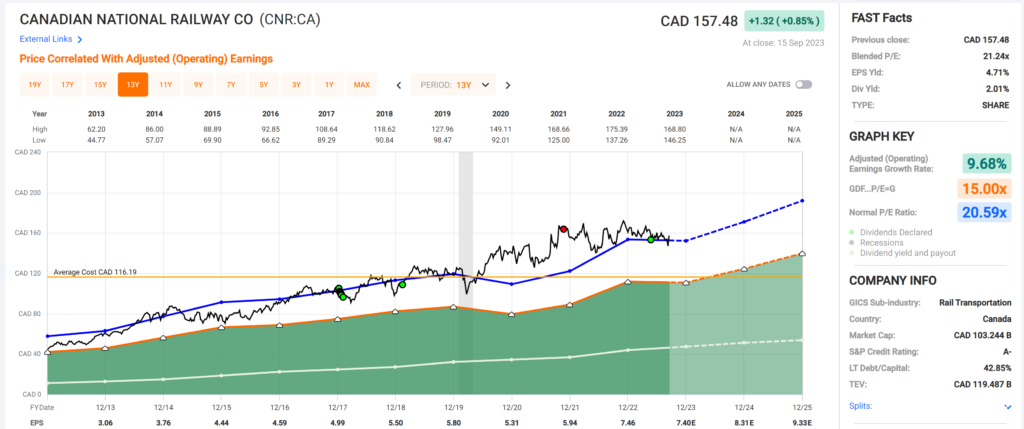
We use one of our quality dividend growers on ‘The List’, Canadian National Railway (CNR-T) to demonstrate:

The ‘Black Line’ represents the price of Canadian National Railway over the past decade, while the ‘Blue Line’ indicates the Normal P/E Ratio it trades at over the same time frame. Notably, there exists a clear correlation between price and P/E for this high-quality dividend growth stock, which we refer to as our ‘valuation corridor.’ Historically, buying when the price falls below the Normal P/E Ratio (20.59) has proven to be an opportune moment to invest, and selling when the price line significantly surpasses this threshold has been a favorable time to divest.

The green dots on the graph mark our purchase points for CNR-T, while the solitary red dot represents the single instance when we decided to sell. While we typically maintain our positions in quality dividend growers exhibiting strong fundamentals, we’ve recently discovered that our returns can be further enhanced by selling when these stocks become significantly overvalued. A detailed explanation of our approach is available in our MP Wealth-Builder Model Portfolio (CDN) Business Plan, accessible to all our subscribers.

Chuck Carnevale’s guidance, akin to a map, has consistently steered us in the right direction on multiple occasions.

If you have not yet joined as a paid subscriber of the blog to receive DGI Alerts on the activity and content related to our model portfolio, it’s not too late. Click Here. 

Recent News 

How TFI International rose from a small Quebec trucker to a North American giant (Globe & Mail)

https://www.theglobeandmail.com/investing/markets/inside-the-market/article-how-tfi-international-rose-from-a-small-quebec-trucker-to-a-north/

“We have many great companies in Canada, some of which few people know about.

One that falls into the under-the-radar category is TFI International Inc. (TFII-T). Based in St. Laurent, a suburb of Montreal, it’s a transportation and logistics giant, whose network spans more than 80 North American cities. It has more than 90 operating companies under its banner and employs some 24,000 people.”

When I first ventured into dividend growth investing, I was pleasantly surprised by some of the companies that made it onto ‘The List’. While I was already familiar with TFI International due to my involvement with one of my operating companies, it had never appeared in the financial news. I quickly learned to appreciate the importance of analyzing cash flow when evaluating the quality of dividend growers. We initially purchased TFI International at $54 in 2020, and within just three years, our investment tripled in value! This remarkable performance led us to include it in our MP Wealth-Builder Model Portfolio (CDN) today.

What Canadians don’t understand about our economic situation – which is a lot – can hurt us (Globe & Mail)

https://www.theglobeandmail.com/business/commentary/article-what-canadians-dont-understand-about-our-economic-situation-which-is-a/

This article provides valuable insights into how many Canadians perceive the state of the economy. The author convincingly argues that a lack of deep understanding about the intricate economic forces at play in today’s world is a cause for concern. This knowledge gap compounds the challenges we face in our current economic climate, which includes issues like carbon taxes, government spending, interest rates and inflation.

The List (2023)

Last updated by BM on September 15, 2023

The Magic Pants List contains 27 Canadian dividend growth stocks. ‘The List’ contains Canadian companies that have raised their dividend yearly for at least the last ten years and have a market cap of over a billion dollars. Below is each stock’s symbol, name, current yield, current price, price return year-to-date, current dividend, dividend growth year-to-date and current dividend growth streak. Companies on ‘The List’ are added or subtracted once a year, on January 1. After that, ‘The List’ is set for the next twelve months. Prices and dividends are updated weekly.

SYMBOL COMPANY YLD PRICE YTD % DIV YTD % STREAK
AQN-N Algonquin Power & Utilities 7.0% $7.20 7.0% $0.51 -29.0% 12
ATD-T Alimentation Couche-Tard Inc. 0.8% $73.39 22.0% $0.56 19.1% 13
BCE-T Bell Canada 6.9% $55.15 -8.4% $3.82 5.0% 14
BIP-N Brookfield Infrastructure Partners 4.4% $32.72 5.2% $1.44 6.3% 15
CCL-B-T CCL Industries 1.8% $57.81 -0.4% $1.06 10.4% 21
CNR-T Canadian National Railway 2.0% $157.48 -3.3% $3.16 7.8% 27
CTC-A-T Canadian Tire 4.4% $155.29 5.9% $6.90 17.9% 12
CU-T Canadian Utilities Limited 5.7% $31.53 -14.6% $1.79 1.0% 51
DOL-T Dollarama Inc. 0.3% $95.63 19.7% $0.27 23.8% 12
EMA-T Emera 5.3% $51.83 -1.5% $2.76 3.0% 16
ENB-T Enbridge Inc. 7.5% $47.60 -10.7% $3.55 3.2% 27
ENGH-T Enghouse Systems Limited 2.7% $31.13 -12.8% $0.85 18.2% 16
FNV-N Franco Nevada 0.9% $143.87 4.1% $1.36 6.3% 15
FTS-T Fortis Inc. 4.0% $56.50 2.1% $2.26 4.1% 49
IFC-T Intact Financial 2.2% $199.89 2.1% $4.40 10.0% 18
L-T Loblaws 1.5% $115.37 -4.1% $1.74 10.3% 11
MGA-N Magna 3.2% $57.23 -0.5% $1.84 2.2% 13
MRU-T Metro 1.7% $72.78 -3.6% $1.21 10.0% 28
RY-T Royal Bank of Canada 4.3% $124.12 -3.1% $5.34 7.7% 12
SJ-T Stella-Jones Inc. 1.4% $65.12 31.3% $0.92 15.0% 18
STN-T Stantec Inc. 0.8% $90.20 38.1% $0.77 8.5% 11
TD-T TD Bank 4.6% $84.10 -4.1% $3.84 7.9% 12
TFII-N TFI International 1.1% $131.12 30.9% $1.40 29.6% 12
TIH-T Toromont Industries 1.5% $112.41 15.0% $1.68 10.5% 33
TRP-T TC Energy Corp. 7.3% $50.68 -4.9% $3.69 3.4% 22
T-T Telus Corp. 6.1% $23.27 -11.6% $1.43 7.4% 19
WCN-N Waste Connections 0.7% $141.79 7.7% $1.02 7.4% 13
Averages 3.3% 4.0% 8.4% 19

Six Canadian stocks on ‘The List’ declare earnings and dividends in US dollars and are inter-listed on a US exchange in US dollars. The simplest way to display dividend and price metrics for these stocks is to show their US exchange symbols along with their US dividends and price. The stocks I am referring to have a -N at the end of their symbols. You can still buy their Canadian counterparts (-T), but your dividends will be converted into CDN dollars and will fluctuate based on the exchange rate.

Note: When the dividend and share price currency match, the calculation is straightforward. But it’s not so simple when the dividend is declared in one currency, and the share price is quoted in another. Dividing the former by the latter would produce a meaningless result because it’s a case of apples and oranges. To calculate the yield properly, you must express the dividend and share price in the same currency.

Performance of ‘The List’

Last week, ‘The List’ was up with a YTD price return of +4.0% (capital). Dividend growth remained the same and is now at +8.4% YTD, highlighting growth in income over the past year.

The best performers last week on ‘The List’ were Dollarama Inc. (DOL-T), up +9.22%; Canadian National Railway (CNR-T), up +7.02%; and Fortis Inc. (FTS-T), up +5.86%.

Loblaws (L-T) was the worst performer last week, down -2.34%.


Dividend Increases

“The growth of dividend paying ability is of significance in the determination of a stock’s quality, or general safety…”

– Arnold Bernhard (the founder of Value Line)

“As a dividend increase is a positive sign of a company’s financial strength, the safest purchase, after research, is a stock with a recent dividend increase.”

– Tom Connolly (the founder of dividendgrowth.ca)

Last week, no dividend increases from companies on ‘The List’.


Earnings Releases

Benjamin Graham once remarked that earnings are the principal factor driving stock prices.

Each quarter we will provide readers with weekly earnings updates of stocks on ‘The List’ during the calendar earnings season. 

The updated earnings calendar can be found here.

Earnings growth and dividend growth tend to go hand in hand, so this information can tell us a lot about the future dividend growth of our quality companies. Monitoring our dividend growers periodically is part of the process, and reading the quarterly earnings releases is a good place to start.

No earnings reports from companies on ‘The List’ this week

Last week, one company on ‘The List’ reported earnings.

Dollarama Inc. (ATD-T) released its second-quarter fiscal 2024 results on Wednesday, September 13, 2023, before markets opened.

“Once again this quarter, we delivered excellent operational and financial results, including notable growth in comparable store sales, EBITDA and earnings per share. Our performance year to date for this fiscal year reflects our differentiated ability to provide compelling value across our broad product mix and a consistent shopping experience. Dollarama continues to deliver unparalleled value to a growing number of consumers seeking affordable everyday products at low price points, and we expect this strong demand to persist through the second half of the year in the current macro-economic context.”

– Neil Rossy, President and CEO

Highlights:

  • 5% increase in comparable store sales
  • 8% growth in EBITDA to $457.2 million, or 31.4% of sales which represents an improvement of 1.0% compared to the same period last year
  • 3% increase in diluted net earnings per share
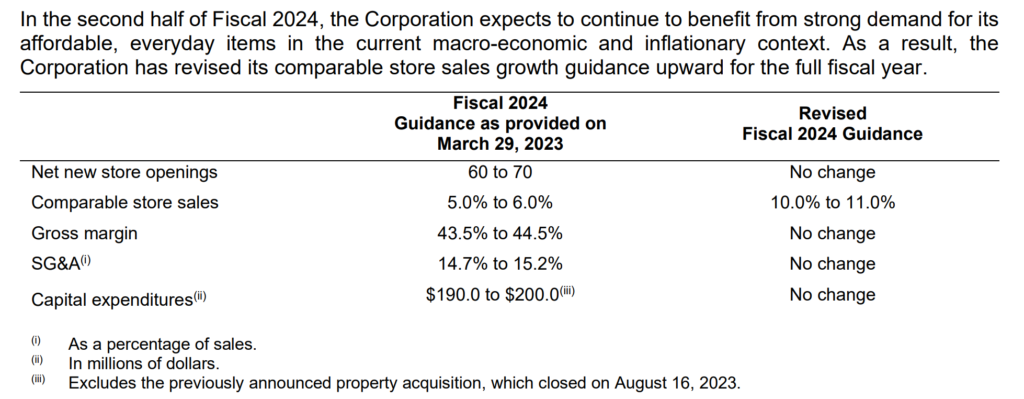
  • Fiscal 2024 guidance range for comparable store sales growth increased to between 10.0% to 11.0%

Outlook:

MP Market Review – September 08, 2023

Last updated by BM on September 11, 2023

Summary 

  • This is a weekly installment of our MP Market Review series, which provides updates on the financial markets and Canadian dividend growth companies we monitor on ‘The List’.
  • Last week, ‘The List’ was down with a YTD price return of +1.7% (capital). Dividend growth remained the same and is now at +8.4% YTD, highlighting growth in income over the past year.
  • Last week, no dividend increases from companies on ‘The List’.
  • Last week, two earnings reports from companies on ‘The List’.
  • One company on ‘The List’ is due to report earnings this week.
  • If you’re interested in creating your own dividend growth income portfolio, consider subscribing to our premium service, which grants you access to the MP Wealth-Builder Model Portfolio (CDN) and exclusive subscriber-only content.  Learn More         

Identifying companies whose dividend growth aligns closely with price growth can considerably enhance the predictability of future returns. Dividend growth investors know that the dividend drives the price in a predictable way, not the other way around. Fortis Inc. (FTS-T) is another company on ‘The List’ that aligns very closely with this dividend growth vs price growth pattern we like to see.

Introduction

“You have a pair of pants. In the left pocket, you have $100. You take $1 out of the left pocket and put it in the right pocket. You now have $101. There is no diminution of dollars in your left pocket. That is one magic pair of pants.”

This ‘magic pants’ analogy was from a Seeking Alpha article on dividend investing I read about a decade ago and was one of the catalysts for me to take a closer look at this type of investing and see if it truly was magical. 

After conducting additional research, I have shifted towards utilizing a dividend growth investing (DGI) strategy as my primary investment approach. While I maintain portfolios consisting of high-quality dividend growers from both the United States and Canada, I have opted to concentrate on Canadian (CDN) dividend growth companies in this blog. This is due to several reasons, including a smaller pool of DGI companies to track, a lack of coverage for the DGI strategy by the North American investment media, and a tendency for those who do cover DGI to narrowly focus on only a handful of sectors (Energy and Financials).

While ‘The List’ is not a portfolio in itself, it serves as an excellent initial reference for individuals seeking to diversify their investments and attain higher returns in the Canadian stock market. Through our blog, we provide weekly updates on ‘The List’ and offer valuable perspectives and real-life examples of the dividend growth investing strategy in practice. This helps readers gain a deeper understanding of how to implement and benefit from this investment approach.


DGI Thoughts

“A stock is not a purchase until it’s yield reaches the buy range established by the stock’s own unique dividend yield history.”

– Anthony Spare, Relative Dividend Yield

With the recent pullback in price last week, for companies on ‘The List’, we felt it was a good time to look at valuation using dividend yield theory as our metric.

Almost half the companies on ‘The List’ are showing a ‘sensible price’ according to dividend yield theory.

If you have not yet joined as a paid subscriber of the blog to receive DGI Alerts on the activity and content related to our model portfolio, it’s not too late. Click Here. 

Recent News 

Dividend investing works wonders – and now’s a great time to start with these three stocks (Globe & Mail)

https://www.theglobeandmail.com/investing/investment-ideas/article-dividend-investing-works-wonders-and-nows-a-great-time-to-start-with/

“While the primary objective of investing in these companies is to generate a steady income through dividends, many of the companies that consistently pay dividends in Canada also exhibit solid growth prospects. This dual benefit allows investors to enjoy the best of both worlds – regular income, and the potential for wealth accumulation over time.”

Some great points about the advantages of a dividend growth investing strategy in this article.

Investors should look beyond Enbridge’s enticing dividend yield (Globe & Mail)

https://www.theglobeandmail.com/investing/markets/inside-the-market/article-investors-enbridge-dividend-yield/

“Big dividends are nice – but only when they come with a rising share price.”

The author correctly points out the pitfalls of seeking out high yield dividend stocks. Let’s hope that Enbridge management knows what they are doing with their recent acquisitions.

The List (2023)

Last updated by BM on September 08, 2023

The Magic Pants List contains 27 Canadian dividend growth stocks. ‘The List’ contains Canadian companies that have raised their dividend yearly for at least the last ten years and have a market cap of over a billion dollars. Below is each stock’s symbol, name, current yield, current price, price return year-to-date, current dividend, dividend growth year-to-date and current dividend growth streak. Companies on ‘The List’ are added or subtracted once a year, on January 1. After that, ‘The List’ is set for the next twelve months. Prices and dividends are updated weekly.

SYMBOL COMPANY YLD PRICE YTD % DIV YTD % STREAK
AQN-N Algonquin Power & Utilities 7.1% $7.11 5.6% $0.51 -29.0% 12
ATD-T Alimentation Couche-Tard Inc. 0.8% $71.50 18.9% $0.56 19.1% 13
BCE-T Bell Canada 6.9% $55.28 -8.2% $3.82 5.0% 14
BIP-N Brookfield Infrastructure Partners 4.4% $31.56 5.2% $1.44 6.3% 15
CCL-B-T CCL Industries 1.8% $58.68 1.1% $1.06 10.4% 21
CNR-T Canadian National Railway 2.1% $147.15 -9.7% $3.16 7.8% 27
CTC-A-T Canadian Tire 4.5% $152.32 3.9% $6.90 17.9% 12
CU-T Canadian Utilities Limited 5.7% $31.61 -14.4% $1.79 1.0% 51
DOL-T Dollarama Inc. 0.3% $87.56 9.6% $0.27 23.8% 12
EMA-T Emera 5.5% $50.06 -4.9% $2.76 3.0% 16
ENB-T Enbridge Inc. 7.8% $45.77 -14.2% $3.55 3.2% 27
ENGH-T Enghouse Systems Limited 2.7% $31.49 -11.8% $0.85 18.2% 16
FNV-N Franco Nevada 1.0% $139.20 0.8% $1.36 6.3% 15
FTS-T Fortis Inc. 4.2% $53.37 -3.6% $2.26 4.1% 49
IFC-T Intact Financial 2.3% $193.25 -1.3% $4.40 10.0% 18
L-T Loblaws 1.5% $118.13 -1.8% $1.74 10.3% 11
MGA-N Magna 3.2% $57.33 -0.3% $1.84 2.2% 13
MRU-T Metro 1.7% $70.73 -6.3% $1.21 10.0% 28
RY-T Royal Bank of Canada 4.4% $120.10 -6.2% $5.34 7.7% 12
SJ-T Stella-Jones Inc. 1.5% $62.46 26.0% $0.92 15.0% 18
STN-T Stantec Inc. 0.9% $89.49 37.0% $0.77 8.5% 11
TD-T TD Bank 4.8% $80.63 -8.0% $3.84 7.9% 12
TFII-N TFI International 1.1% $131.63 31.5% $1.40 29.6% 12
TIH-T Toromont Industries 1.5% $110.54 13.1% $1.68 10.5% 33
TRP-T TC Energy Corp. 7.5% $49.05 -8.0% $3.69 3.4% 22
T-T Telus Corp. 6.3% $22.84 -13.2% $1.43 7.4% 19
WCN-N Waste Connections 0.7% $137.84 4.7% $1.02 7.4% 13
Averages 3.4% 1.7% 8.4% 19

Six Canadian stocks on ‘The List’ declare earnings and dividends in US dollars and are inter-listed on a US exchange in US dollars. The simplest way to display dividend and price metrics for these stocks is to show their US exchange symbols along with their US dividends and price. The stocks I am referring to have a -N at the end of their symbols. You can still buy their Canadian counterparts (-T), but your dividends will be converted into CDN dollars and will fluctuate based on the exchange rate.

Note: When the dividend and share price currency match, the calculation is straightforward. But it’s not so simple when the dividend is declared in one currency, and the share price is quoted in another. Dividing the former by the latter would produce a meaningless result because it’s a case of apples and oranges. To calculate the yield properly, you must express the dividend and share price in the same currency.

Performance of ‘The List’

Last week, ‘The List’ was down with a YTD price return of +1.7% (capital). Dividend growth remained the same and is now at +8.4% YTD, highlighting growth in income over the past year.

The best performers last week on ‘The List’ were Enghouse Systems Limited (ENGH-T), up +2.57%; Metro (MRU-T), up +0.33%; and Fortis Inc. (FTS-T), down -0.06%.

Algonquin Power & Utilities (AQN-N) was the worst performer last week, down -6.82%.


Dividend Increases

“The growth of dividend paying ability is of significance in the determination of a stock’s quality, or general safety…”

– Arnold Bernhard (the founder of Value Line)

“As a dividend increase is a positive sign of a company’s financial strength, the safest purchase, after research, is a stock with a recent dividend increase.”

– Tom Connolly (the founder of dividendgrowth.ca)

Last week, no dividend increases from companies on ‘The List’.


Earnings Releases

Benjamin Graham once remarked that earnings are the principal factor driving stock prices.

Each quarter we will provide readers with weekly earnings updates of stocks on ‘The List’ during the calendar earnings season. 

The updated earnings calendar can be found here.

Earnings growth and dividend growth tend to go hand in hand, so this information can tell us a lot about the future dividend growth of our quality companies. Monitoring our dividend growers periodically is part of the process, and reading the quarterly earnings releases is a good place to start.

One earnings report from companies on ‘The List’ this week

Dollarama Inc. (ATD-T) will release its second-quarter fiscal 2024 results on Wednesday, September 13, 2023, before markets open.

Last week, two companies on ‘The List’ reported earnings.

Alimentation Couche-Tard Inc. (ATD-T) released its first-quarter fiscal 2024 results on Wednesday, September 6, 2023, after markets closed.

“We are pleased to announce a good first quarter of our new fiscal year, with our Canadian operations leading the way with strong performances in both convenience and fuel. Same store sales continued to grow in all Canadian business units with our packaged beverages category performing exceptionally well. Fuel volumes also grew significantly in this region. Across North America, we are seeing benefit from our promotional initiatives including reoccurring fuel days, which are contributing to volume growth. At the end of August, we had our first ever global Couche-Tard/Circle K Day with limited-time food and fuel discounts across our network from Hong Kong, to Europe, and coast to coast in North America. With inflationary conditions continuing across the globe, our focus has remained on providing value and ease to our customers both inside our stores and on our forecourts.”

– Brian Hannasch, President and CEO

Highlights:

  • Net earnings were $834.1 million, or $0.85 per diluted share for the first quarter of fiscal 2024 compared with $872.4 million, or $0.85 per diluted share for the first quarter of fiscal 2023. Adjusted net earnings1 were approximately $838.0 million compared with $875.0 million for the first quarter of fiscal 2023. Adjusted diluted net earnings per share were $0.86, representing an increase of 1.2% from $0.85 for the corresponding quarter of last year.
  • Total merchandise and service revenues of $4.3 billion, an increase of 5.0%. Same-store merchandise revenues increased by 2.1% in the United States, by 2.7% in Europe and other regions, and by 6.4% in Canada.
  • Merchandise and service gross margin increased by 0.4% in the United States to 34.3%, by 1.0% in Europe and other regions to 39.9%, and by 0.8% in Canada to 33.9%, all impacted favorably by a change in product mix.
  • Same-store road transportation fuel volumes increased by 0.7% in the United States, by 7.2% in Canada, and decreased by 1.5% in Europe and other regions.
  • Road transportation fuel gross margin of 50.05¢ per gallon in the United States, an increase of 1.05¢ per gallon, and of CA 13.25¢ per liter in Canada, a decrease of CA 0.79¢ per liter. Fuel margins remained healthy throughout the North American network, due to favorable market conditions and the continued work on the optimization of the supply chain. In Europe and other regions, the road transportation fuel margin was US 8.21¢ per liter, a decrease of US 4.05¢ per liter, mostly driven by the volatility of the global fuel market, more impactful to the Corporation’s European gross margin due to a more integrated supply chain model in this region.
  • Growth of expenses for the first quarter of fiscal 2024 was 2.9% while normalized growth of expenses was 3.7%, remaining below the average inflation observed throughout the Corporation’s network.
  • During the quarter, the Corporation reached an agreement to acquire 2,193 sites from TotalEnergies SE located in Germany, Belgium, Netherlands and Luxembourg.
  • During the first quarter of fiscal 2024, the Corporation repurchased 4.7 million shares for an amount of $230.0 million. Subsequent to the end of the first quarter of fiscal 2024 and under the share repurchase program, the Corporation repurchased 10.8 million shares through a private agreement, for an amount of $529.7 million.

Outlook:

At our 2023 Analyst and Investor Conference, we look forward to communicating our new multi-year strategic plan which will include a renewed focus on cost reduction initiatives. Finally, in terms of capital allocation, the recent private buyback transaction, which took place shortly after quarter-end, highlights a great use of our excess cash and will further enhance our key return metrics.

Source: (ATD-T) Q1-2024 Earnings Results


Enghouse Systems Limited (ENGH-T) released its third-quarter fiscal 2023 results on Thursday, September 7, 2023, after markets closed.

“During the third quarter of 2023, we generated an increase in revenue, operating cash flows and operating income. We also continued the integration of the recent acquisitions of Qumu Corporation (“Qumu”) and Mobil All Technologies S.A (“Navita”). Operationally, both businesses were profitable in the third quarter of 2023 with margin improvement. Although these acquisitions were still dilutive to our overall margins this quarter, we are pleased with the integration speed of these recent acquisitions and our achievements of improving Qumu, which had substantial losses over many years prior to Enghouse acquiring it and running it profitably.”

– Stephen J. Sadler, CEO

Highlights:

  • Revenue increased 8.7%, notably, while expanding our recurring revenue 13.8% to $72.3 million compared to the same period in the prior year.
  • Operating profits improved, with a 30.1% EBITDA margin.
  • Operating cash flows increased as a result of improved operating profits and cash collections.

Outlook:

Subsequent to quarter end, on August 1, 2023, Enghouse completed the acquisition of substantially all the assets of Lifesize Inc., a cloud communications company. The acquisition was completed for a purchase price of approximately USD $20.7 million, bringing our total capital deployed on acquisitions in the year to over $56.0 million as of August 1, 2023. The macroeconomic environment of increasing interest rates and a more difficult funding environment for technology companies continues to generate more acquisition opportunities for Enghouse that meet our financial and operational criteria.

Source: (ENGH-T) Q3-2023 Earnings Results


MP Market Review – September 01, 2023

Last updated by BM on September 04, 2023

Summary 

  • This is a weekly installment of our MP Market Review series, which provides updates on the financial markets and Canadian dividend growth companies we monitor on ‘The List’.
  • Last week, ‘The List’ was up with a YTD price return of +4.1% (capital). Dividend growth remained the same and is now at +8.4% YTD, highlighting growth in income over the past year.
  • Last week, no dividend increases from companies on ‘The List’.
  • Last week, no earnings reports from companies on ‘The List’.
  • Two companies on ‘The List’ are due to report earnings this week.
  • If you’re interested in creating your own dividend growth income portfolio, consider subscribing to our premium service, which grants you access to the MP Wealth-Builder Model Portfolio (CDN) and exclusive subscriber-only content.  Learn More         

Identifying companies whose dividend growth aligns closely with price growth can considerably enhance the predictability of future returns. Dividend growth investors know that the dividend drives the price in a predictable way, not the other way around. Fortis Inc. (FTS-T) is another company on ‘The List’ that aligns very closely with this dividend growth vs price growth pattern we like to see.

Introduction

“You have a pair of pants. In the left pocket, you have $100. You take $1 out of the left pocket and put it in the right pocket. You now have $101. There is no diminution of dollars in your left pocket. That is one magic pair of pants.”

This ‘magic pants’ analogy was from a Seeking Alpha article on dividend investing I read about a decade ago and was one of the catalysts for me to take a closer look at this type of investing and see if it truly was magical. 

After conducting additional research, I have shifted towards utilizing a dividend growth investing (DGI) strategy as my primary investment approach. While I maintain portfolios consisting of high-quality dividend growers from both the United States and Canada, I have opted to concentrate on Canadian (CDN) dividend growth companies in this blog. This is due to several reasons, including a smaller pool of DGI companies to track, a lack of coverage for the DGI strategy by the North American investment media, and a tendency for those who do cover DGI to narrowly focus on only a handful of sectors (Energy and Financials).

While ‘The List’ is not a portfolio in itself, it serves as an excellent initial reference for individuals seeking to diversify their investments and attain higher returns in the Canadian stock market. Through our blog, we provide weekly updates on ‘The List’ and offer valuable perspectives and real-life examples of the dividend growth investing strategy in practice. This helps readers gain a deeper understanding of how to implement and benefit from this investment approach.


DGI Thoughts

“If a portfolio manager has pressure to succeed in the short term, they will likely make suboptimal long-term decisions.”

– Tom Connolly, dividendgrowth.ca blog

Because of the strong focus on short-term results, many portfolio managers fail to establish investment processes conducive to achieving long-term outcomes.

Tom Connolly believes that they behave this way in fear of losing their jobs (career risk). They are forced to buy/do what other professionals do so they won’t be wrong. They all fail together. Patrick Keogh of Make Your Family Rich fame believes their lawyers won’t let them invest in a concentrated portfolio of equities for fear of being sued. Whatever you believe, the results of this industry have been dismal.

Another study, which can be found in the ‘Recent News’ section below, reaffirms what we already know. Due to a combination of high fees and poor security selection, the vast majority of portfolio managers underperform their benchmarks over extended periods.

Study results:

  • 84 percent underperformance over three years
  • 93 percent underperformance over five years
  • 95 percent underperformance over twenty years

For those genuinely interested in changing this narrative, please keep an eye on your inbox later this week. I will be sending a ‘Subscriber Only’ article regarding the quarterly performance of our Wealth-Builder Model Portfolio (CDN) after just fifteen months. By focusing on growing cash flow (income) in the short term our companies deliver above-average capital returns down the road. That is how we win!

If you have not yet joined as a paid subscriber of the blog to receive DGI Alerts on the activity and content related to our model portfolio, it’s not too late. Click Here. 

Recent News 

Want to boost investment income and diversification? Consider dividend ETFs (Globe & Mail)

https://www.theglobeandmail.com/investing/markets/etfs/article-want-to-boost-investment-income-and-diversification-consider-dividend/

“You want to go underneath the hood to really understand what you are investing in, and the underlying methodology used in selecting stocks,” Mr. Heakes says.

Stay clear of dividend funds and ETFs that are focused on yield. It is very difficult to find one that uses a ‘quality first’ methodology in selecting stocks. That is why dividend growth investors build their own portfolios.

Why the TSX is set to outperform U.S. stocks over the next 10 years (Globe & Mail)

https://www.theglobeandmail.com/investing/investment-ideas/article-why-the-tsx-is-set-to-outperform-us-stocks-over-the-next-10-years/

The most interesting part of this article for me was the reference to a recent S&P Dow Jones publication that confirmed the results of many previous papers on the subject. Owing to a combination of high fees and adverse security selection, the vast majority of fund managers underperform their benchmark over the long term.

“According to the report, 52 per cent of funds in Canada underperformed their benchmark in 2022. This figure increased to 84 per cent over a three-year period and finally 93 per cent over the past five years. In the U.S., the study went back 20 years, and indeed even greater underperformance occurred, with 95 per cent of funds tracking the S&P 500 not meeting their benchmark.”

Unfortunately for most, they will assume that the alternative is to purchase a low-cost ETF that tracks the benchmark. Fortunately for dividend growth investors we know better.

The List (2023)

Last updated by BM on September 01, 2023

The Magic Pants List contains 27 Canadian dividend growth stocks. ‘The List’ contains Canadian companies that have raised their dividend yearly for at least the last ten years and have a market cap of over a billion dollars. Below is each stock’s symbol, name, current yield, current price, price return year-to-date, current dividend, dividend growth year-to-date and current dividend growth streak. Companies on ‘The List’ are added or subtracted once a year, on January 1. After that, ‘The List’ is set for the next twelve months. Prices and dividends are updated weekly.

SYMBOL COMPANY YLD PRICE YTD % DIV YTD % STREAK
AQN-N Algonquin Power & Utilities 6.6% $7.63 13.4% $0.51 -29.0% 12
ATD-T Alimentation Couche-Tard Inc. 0.8% $72.39 20.4% $0.56 19.1% 13
BCE-T Bell Canada 6.8% $56.40 -6.4% $3.82 5.0% 14
BIP-N Brookfield Infrastructure Partners 4.4% $32.25 5.2% $1.44 6.3% 15
CCL-B-T CCL Industries 1.7% $60.84 4.8% $1.06 10.4% 21
CNR-T Canadian National Railway 2.1% $153.91 -5.5% $3.16 7.8% 27
CTC-A-T Canadian Tire 4.3% $159.48 8.8% $6.90 17.9% 12
CU-T Canadian Utilities Limited 5.6% $32.28 -12.6% $1.79 1.0% 51
DOL-T Dollarama Inc. 0.3% $88.57 10.9% $0.27 23.8% 12
EMA-T Emera 5.4% $51.27 -2.6% $2.76 3.0% 16
ENB-T Enbridge Inc. 7.3% $48.30 -9.4% $3.55 3.2% 27
ENGH-T Enghouse Systems Limited 2.8% $30.70 -14.0% $0.85 18.2% 16
FNV-N Franco Nevada 0.9% $143.54 3.9% $1.36 6.3% 15
FTS-T Fortis 4.2% $53.40 -3.5% $2.26 4.1% 49
IFC-T Intact Financial 2.3% $193.99 -0.9% $4.40 10.0% 18
L-T Loblaws 1.5% $118.57 -1.5% $1.74 10.3% 11
MGA-N Magna 3.1% $58.95 2.5% $1.84 2.2% 13
MRU-T Metro 1.7% $70.50 -6.6% $1.21 10.0% 28
RY-T Royal Bank of Canada 4.3% $122.85 -4.0% $5.34 7.7% 12
SJ-T Stella-Jones Inc. 1.4% $65.53 32.2% $0.92 15.0% 18
STN-T Stantec Inc. 0.8% $90.85 39.1% $0.77 8.5% 11
TD-T TD Bank 4.6% $83.27 -5.0% $3.84 7.9% 12
TFII-N TFI International 1.0% $137.53 37.4% $1.40 29.6% 12
TIH-T Toromont Industries 1.5% $112.63 15.3% $1.68 10.5% 33
TRP-T TC Energy Corp. 7.5% $49.51 -7.1% $3.69 3.4% 22
T-T Telus Corp. 6.0% $23.81 -9.5% $1.43 7.4% 19
WCN-N Waste Connections 0.7% $139.29 5.8% $1.02 7.4% 13
Averages 3.3% 4.1% 8.4% 19

Six Canadian stocks on ‘The List’ declare earnings and dividends in US dollars and are inter-listed on a US exchange in US dollars. The simplest way to display dividend and price metrics for these stocks is to show their US exchange symbols along with their US dividends and price. The stocks I am referring to have a -N at the end of their symbols. You can still buy their Canadian counterparts (-T), but your dividends will be converted into CDN dollars and will fluctuate based on the exchange rate.

Note: When the dividend and share price currency match, the calculation is straightforward. But it’s not so simple when the dividend is declared in one currency, and the share price is quoted in another. Dividing the former by the latter would produce a meaningless result because it’s a case of apples and oranges. To calculate the yield properly, you must express the dividend and share price in the same currency.

Performance of ‘The List’

Last week, ‘The List’ was up with a YTD price return of +4.1% (capital). Dividend growth remained the same and is now at +8.4% YTD, highlighting growth in income over the past year.

The best performers last week on ‘The List’ were TFI International (TFII-N), up +8.01%; Canadian Tire (CTC-A-T), up +4.49%; and Enghouse Systems Limited (ENGH-T), up +4.17%.

Intact Financial (IFC-T) was the worst performer last week, down -0.35%.


Dividend Increases

“The growth of dividend paying ability is of significance in the determination of a stock’s quality, or general safety…”

– Arnold Bernhard (the founder of Value Line)

“As a dividend increase is a positive sign of a company’s financial strength, the safest purchase, after research, is a stock with a recent dividend increase.”

– Tom Connolly (the founder of dividendgrowth.ca)

Last week, no dividend increases from companies on ‘The List’.


Earnings Releases

Benjamin Graham once remarked that earnings are the principal factor driving stock prices.

Each quarter we will provide readers with weekly earnings updates of stocks on ‘The List’ during the calendar earnings season. 

The updated earnings calendar can be found here.

Earnings growth and dividend growth tend to go hand in hand, so this information can tell us a lot about the future dividend growth of our quality companies. Monitoring our dividend growers periodically is part of the process, and reading the quarterly earnings releases is a good place to start.

Two earnings reports from companies on ‘The List’ this week

Alimentation Couche-Tard Inc. (ATD-T) will release its first-quarter fiscal 2024 results on Wednesday, September 6, 2023, after markets close.

Enghouse Systems Limited (ENGH-T) will release its third-quarter fiscal 2023 results on Thursday, September 7, 2023, after markets close.

Last week, no companies on ‘The List’ reported earnings.
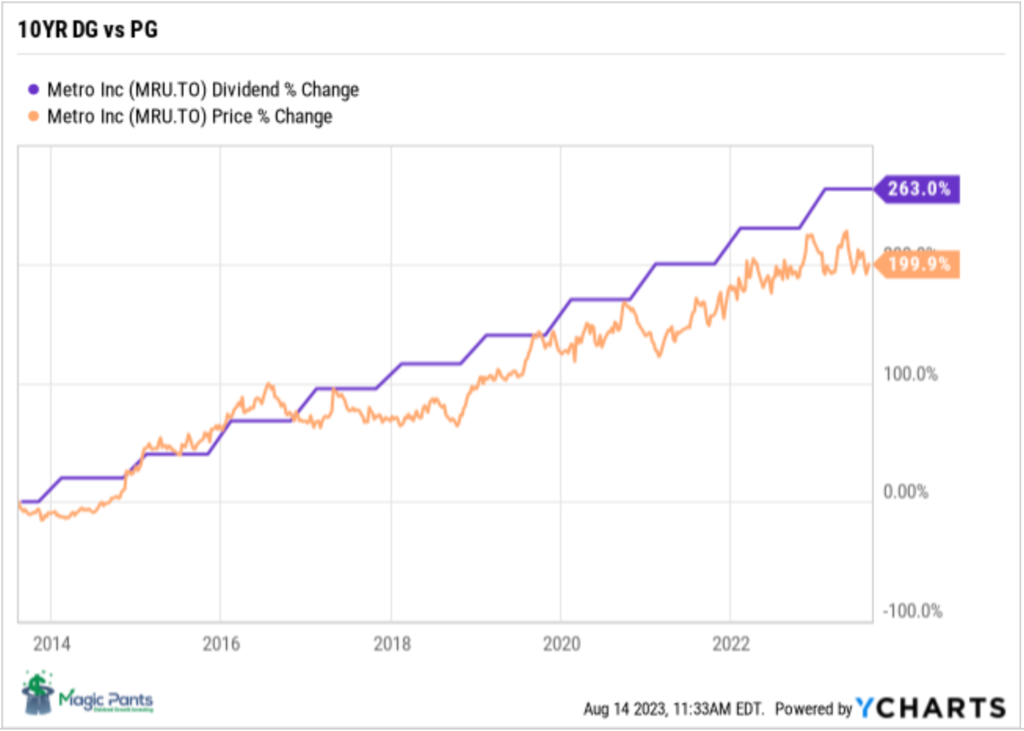
 

MP Market Review – August 25, 2023

Last updated by BM on August 28, 2023

Summary 

  • This is a weekly installment of our MP Market Review series, which provides updates on the financial markets and Canadian dividend growth companies we monitor on ‘The List’.
  • Last week, ‘The List’ was up with a YTD price return of +1.9% (capital). Dividend growth remained the same and is now at +8.4% YTD, highlighting growth in income over the past year.
  • Last week, no dividend increases from companies on ‘The List’.
  • Last week, two earnings reports from companies on ‘The List’.
  • No companies on ‘The List’ are due to report earnings this week.
  • If you’re interested in creating your own dividend growth income portfolio, consider subscribing to our premium service, which grants you access to the MP Wealth-Builder Model Portfolio (CDN) and exclusive subscriber-only content.  Learn More         

Identifying companies whose dividend growth aligns closely with price growth can considerably enhance the predictability of future returns. Dividend growth investors know that the dividend drives the price in a predictable way, not the other way around. Metro Inc. (MRU-T) is another company on ‘The List’ that follows this dividend growth principle.

Introduction

“You have a pair of pants. In the left pocket, you have $100. You take $1 out of the left pocket and put it in the right pocket. You now have $101. There is no diminution of dollars in your left pocket. That is one magic pair of pants.”

This ‘magic pants’ analogy was from a Seeking Alpha article on dividend investing I read about a decade ago and was one of the catalysts for me to take a closer look at this type of investing and see if it truly was magical. 

After conducting additional research, I have shifted towards utilizing a dividend growth investing (DGI) strategy as my primary investment approach. While I maintain portfolios consisting of high-quality dividend growers from both the United States and Canada, I have opted to concentrate on Canadian (CDN) dividend growth companies in this blog. This is due to several reasons, including a smaller pool of DGI companies to track, a lack of coverage for the DGI strategy by the North American investment media, and a tendency for those who do cover DGI to narrowly focus on only a handful of sectors (Energy and Financials).

While ‘The List’ is not a portfolio in itself, it serves as an excellent initial reference for individuals seeking to diversify their investments and attain higher returns in the Canadian stock market. Through our blog, we provide weekly updates on ‘The List’ and offer valuable perspectives and real-life examples of the dividend growth investing strategy in practice. This helps readers gain a deeper understanding of how to implement and benefit from this investment approach.


DGI Thoughts

“Experience is the worst teacher. It gives the test before giving the lesson.”

– Brendan Moynihan, What I Learned Losing A Million Dollars

The quote is from a book I am reading now. The book highlights an investor who was doing quite well until he wasn’t. It turns out that being lucky versus being good (having a process) can cost you a lot of money.

A short story I read a while back highlights this concept quite well.

Being Lucky vs Being Good– Vishal Khandelwal

Let’s say you sponsor a contest to determine the “world’s best coin flippers.” About 100,000 people from across the world come together to participate in this contest. Everyone flips a coin at the same time.

After each coin flip, those who flip “tails” must leave, until the only people left have flipped 10 consecutive heads. Basic statistics suggest that we could expect about 98 coin flippers to remain at the end of the contest.

The odds of flipping heads 10 times in a row are 1/2^10 = 1/1024. So, for 100,000 participants, there will be 100,000/1,024 = 98 people who would have flipped 10 consecutive heads.

Then, these 98 “skilled” coin flippers would get thousands of likes on Facebook, and followers on Twitter. Those with the best smile and social media skills will write bestselling books about coin flipping, sharing their secrets of how to become a world-class coin flipper.

Sadly, most of us judge the quality of our decisions and actions by one single factor, and that is our one-off good performance that comes easily at the very beginning of our endeavour.

Investing is not any different. As investors, we often struggle with judging whether a decision was good or not, even in hindsight, because like the winning coin flippers we often only look at the outcome and not the process. The truth, however, is that a good process is the only thing that could help you bring the odds of success in your favour. It’s only with a good process that you stand a chance to do well in investing over the long run.

If you have not yet joined as a paid subscriber of the blog to receive DGI Alerts on the activity and content related to our model portfolio, it’s not too late. Click Here. 

Recent News 

The Canadian economy is mired in weak fundamentals and investors are taking note (Globe & Mail)

https://www.theglobeandmail.com/investing/markets/inside-the-market/article-david-rosenberg-the-canadian-economy-is-mired-in-weak-fundamentals-and/

“From a big-picture standpoint, the Canadian economy is mired in weak fundamentals.”

The article points to several reasons why we may anticipate further challenges, with rising immigration levels and a falling GDP being the most concerning.

“Productivity in Canada has declined by 1.4 percent year-over-year and has contracted sequentially for four consecutive quarters, as well as in 10 of the past 11 quarters.”

Our recent Q2 earnings reporting season appears to support this perspective, as over 50% of companies on ‘The List’ failed to outperform the same quarter of the previous year. Reviewing the recent Q3 earnings results from the Canadian Banks on ‘The List’ emphasizes this even more.

We will remain vigilant and enhance our growing income during periods of volatility by acquiring our quality dividend growth stocks at ‘sensible prices’.

Two high-yielding stocks with million-dollar purchases (Globe & Mail)

https://www.theglobeandmail.com/investing/markets/inside-the-market/article-mondays-insider-report-two-high-yielding-stocks-with-million-dollar/

“I tend to put great weight on insider transaction activity when I see multiple insiders trading a company’s shares or units.”

The author uses insider transaction activity as an indicator of a ‘sensible price’.

The two stocks he is referring to are on ‘The List’ we follow (EMA-T and T-T).

The List (2023)

Last updated by BM on August 25, 2023

The Magic Pants List contains 27 Canadian dividend growth stocks. ‘The List’ contains Canadian companies that have raised their dividend yearly for at least the last ten years and have a market cap of over a billion dollars. Below is each stock’s symbol, name, current yield, current price, price return year-to-date, current dividend, dividend growth year-to-date and current dividend growth streak. Companies on ‘The List’ are added or subtracted once a year, on January 1. After that, ‘The List’ is set for the next twelve months. Prices and dividends are updated weekly.

SYMBOL COMPANY YLD PRICE YTD % DIV YTD % STREAK
AQN-N Algonquin Power & Utilities 6.9% $7.39 9.8% $0.51 -29.0% 12
ATD-T Alimentation Couche-Tard Inc. 0.8% $71.29 18.5% $0.56 19.1% 13
BCE-T Bell Canada 6.8% $56.32 -6.5% $3.82 5.0% 14
BIP-N Brookfield Infrastructure Partners 4.4% $31.86 5.2% $1.44 6.3% 15
CCL-B-T CCL Industries 1.8% $60.05 3.4% $1.06 10.4% 21
CNR-T Canadian National Railway 2.1% $152.98 -6.1% $3.16 7.8% 27
CTC-A-T Canadian Tire 4.5% $152.63 4.1% $6.90 17.9% 12
CU-T Canadian Utilities Limited 5.6% $32.19 -12.9% $1.79 1.0% 51
DOL-T Dollarama Inc. 0.3% $85.81 7.5% $0.27 23.8% 12
EMA-T Emera 5.4% $50.74 -3.6% $2.76 3.0% 16
ENB-T Enbridge Inc. 7.6% $46.83 -12.2% $3.55 3.2% 27
ENGH-T Enghouse Systems Limited 2.9% $29.47 -17.5% $0.85 18.2% 16
FNV-N Franco Nevada 1.0% $138.47 0.2% $1.36 6.3% 15
FTS-T Fortis 4.2% $53.43 -3.5% $2.26 4.1% 49
IFC-T Intact Financial 2.3% $194.68 -0.6% $4.40 10.0% 18
L-T Loblaws 1.5% $116.55 -3.1% $1.74 10.3% 11
MGA-N Magna 3.3% $56.54 -1.7% $1.84 2.2% 13
MRU-T Metro 1.7% $69.90 -7.4% $1.21 10.0% 28
RY-T Royal Bank of Canada 4.4% $121.02 -5.5% $5.34 7.7% 12
SJ-T Stella-Jones Inc. 1.4% $64.69 30.5% $0.92 15.0% 18
STN-T Stantec Inc. 0.8% $90.22 38.1% $0.77 8.5% 11
TD-T TD Bank 4.8% $80.37 -8.3% $3.84 7.9% 12
TFII-N TFI International 1.1% $127.33 27.2% $1.40 29.6% 12
TIH-T Toromont Industries 1.5% $110.36 12.9% $1.68 10.5% 33
TRP-T TC Energy Corp. 7.7% $48.07 -9.8% $3.69 3.4% 22
T-T Telus Corp. 6.1% $23.35 -11.3% $1.43 7.4% 19
WCN-N Waste Connections 0.7% $137.86 4.7% $1.02 7.4% 13
Averages 3.4% 1.9% 8.4% 19

Six Canadian stocks on ‘The List’ declare earnings and dividends in US dollars and are inter-listed on a US exchange in US dollars. The simplest way to display dividend and price metrics for these stocks is to show their US exchange symbols along with their US dividends and price. The stocks I am referring to have a -N at the end of their symbols. You can still buy their Canadian counterparts (-T), but your dividends will be converted into CDN dollars and will fluctuate based on the exchange rate.

Note: When the dividend and share price currency match, the calculation is straightforward. But it’s not so simple when the dividend is declared in one currency, and the share price is quoted in another. Dividing the former by the latter would produce a meaningless result because it’s a case of apples and oranges. To calculate the yield properly, you must express the dividend and share price in the same currency.

Performance of ‘The List’

Feel free to click on this link, ‘The List’ for a sortable version from our website.

Last week, ‘The List’ was up with a YTD price return of +1.9% (capital). Dividend growth remained the same and is now at +8.4% YTD, highlighting growth in income over the past year.

The best performers last week on ‘The List’ were Enghouse Systems Limited (ENGH-T), up +5.17%; Algonquin Power & Utilities (AQN-N), up +2.64%; and Alimentation Couche-Tard Inc. (ATD-T), up +2.58%.

TD Bank (TD-T) was the worst performer last week, down -4.24%.


Dividend Increases

“The growth of dividend paying ability is of significance in the determination of a stock’s quality, or general safety…”

– Arnold Bernhard (the founder of Value Line)

“As a dividend increase is a positive sign of a company’s financial strength, the safest purchase, after research, is a stock with a recent dividend increase.”

– Tom Connolly (the founder of dividendgrowth.ca)

Last week, no dividend increases from companies on ‘The List’.


Earnings Releases

Benjamin Graham once remarked that earnings are the principal factor driving stock prices.

Each quarter we will provide readers with weekly earnings updates of stocks on ‘The List’ during the calendar earnings season. 

The updated earnings calendar can be found here.

Earnings growth and dividend growth tend to go hand in hand, so this information can tell us a lot about the future dividend growth of our quality companies. Monitoring our dividend growers periodically is part of the process, and reading the quarterly earnings releases is a good place to start.

No earnings reports from companies on ‘The List’ this week

Last week, two companies on ‘The List’ reported earnings.
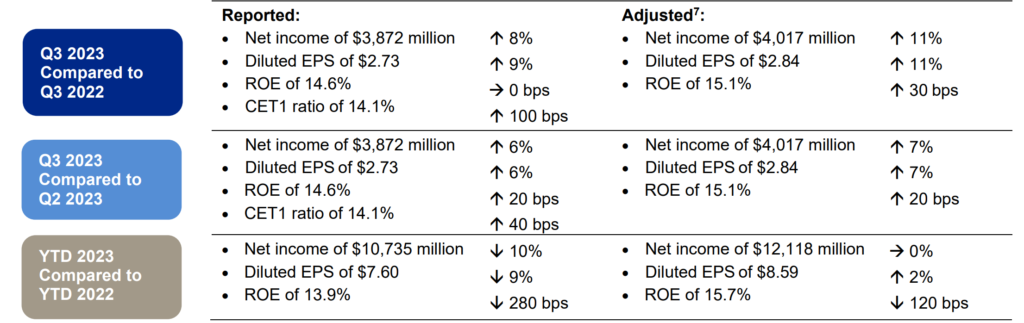
Royal Bank of Canada (RY-T) released its third-quarter fiscal 2023 results on Thursday, August 24, 2023, before markets opened.

“Despite a complex operating environment, our Q3 results exemplify RBC’s ability to consistently deliver solid revenue and volume growth underpinned by prudent risk management. We remain focused on executing on our cost reduction strategy while leveraging our strong balance sheet and diversified business model to support our growth and bring long-term value to our clients, communities and shareholders.”

– Dave McKay, President and Chief Executive Officer of Royal Bank of Canada

Highlights:

Outlook:

The near-term macroeconomic backdrop has been more resilient than expected with unemployment rates remaining low across most advanced economies despite increases in interest rates over the last calendar year. Inflation has slowed with energy prices falling below calendar year-ago levels and global supply chain pressures have substantially eased. However, inflation is unlikely to reduce to central bank target rates without some slowing in consumer spending and higher unemployment. Central banks have responded with additional interest rate increases. More recently, there have been early signs that economic growth is slowing. Consumer delinquency rates, as published by the Bank of Canada, have been edging higher and the unemployment rate has begun to rise in Canada. We continue to expect mild recessions in the U.S. and Canada beginning in the second half of calendar 2023.

Source: (RY-T) Q3-2023 Earnings Results


TD Bank (TD-T) released its third-quarter fiscal 2023 results on Thursday, August 24, 2023, before markets opened.

“TD delivered strong revenue growth in the quarter and demonstrated the value of its diversified business mix in a challenging economic environment. Investments across our business further strengthened the Bank’s ability to deliver legendary experiences to more than 27 million customers.”

– Bharat Masrani, Group President and Chief Executive Officer

Highlights:

  • Reported diluted earnings per share were $1.57, compared with $1.75.
  • Adjusted diluted earnings per share were $1.99, compared with $2.09.
  • Reported net income was $2,963 million, compared with $3,214 million.
  • Adjusted net income was $3,731 million, compared with $3,813 million.

Outlook:

The global economy remains on track to slow in calendar 2023, but to a lesser extent than anticipated in the previous quarter. As a result, inflation rates across the G-7 have stayed elevated, and central banks have raised interest rates further. The lagged impact of cumulative interest rate hikes is expected to be the primary influence dampening economic growth and returning inflation closer to the target ranges of the various regions by the end of 2024. The impact of bank failures in the U.S. earlier this year has had a more modest impact than initially anticipated.

The U.S. economy expanded by 2.4% annualized in the second calendar quarter of 2023. Underlying domestic demand grew at a healthy 2.3% pace, as business investment accelerated after a soft performance in the first calendar quarter. Consumer spending slowed, while real income growth improved alongside lower inflation. Housing activity continued to weigh on economic growth, as a modest improvement in new home construction was not enough to outweigh weakness in the resale market.

As of July, the U.S. job market was still tight with the unemployment rate at 3.5% in July, close to its multi-decade low. However, there are signs that demand for workers is cooling, as evidenced by both slower trend growth in payrolls and gradually declining job openings. Helped by lower gasoline prices, inflation metrics have been moderating in recent months. Underlying services prices, which have been a source of persistent price pressure, have also started to cool. Nonetheless, inflation remains well above the U.S. Federal Reserve’s 2% target and the central bank remains highly attentive to upside inflation risks.

TD Economics expects the federal funds rate will remain at its current range of 5.25-5.50% through the end of calendar 2023. However, the economic environment remains fluid. The central bank could embark on additional interest rate hikes if a further cooling in the labour market and inflation do not materialize in line with its expectations. Given the steep rise in interest rates over the past year, the trend towards tighter U.S. credit conditions and the likelihood of rolling periods of financial stress related to risk factors, the probability of a recession stateside remains elevated.

The Canadian economy recorded a solid 3.1% annualized rate of expansion in the first calendar quarter of 2023, reflecting a rebound from a soft showing registered in the fourth calendar quarter of 2022. Despite the financial impact of rising interest costs on highly indebted households, consumer spending was strong, supported by population growth, strong job market conditions, excess savings and increased government supports. The housing sector remained a drag on economic growth in the first calendar quarter but has since shown signs of stabilization.

Canadian inflation has moderated, although progress on core inflation metrics has been slow. The trend rate of job growth has slowed below that of the labour force, pushing the unemployment rate higher. TD Economics expects the unemployment rate to continue to move higher in the months ahead. That is expected to contribute to a downturn in consumer spending through the first half of 2024. Given the uncertainty surrounding the impact of substantial interest rate hikes on highly indebted Canadian households, the risk of recession also remains elevated in Canada.

The Bank of Canada raised the overnight interest rate in July to 5.00%, and expressed concern about the persistence of underlying inflation. The incoming economic data will determine whether more interest rate hikes will be required in Canada to bring inflation down to the 2% target. The Canadian dollar is expected to hover around the 75 U.S. cent mark in calendar 2023.

Source: (TD-T) Q3-2023 Earnings Results

MP Market Review – August 18, 2023

Last updated by BM on August 21, 2023

Summary 

  • This is a weekly installment of our MP Market Review series, which provides updates on the financial markets and Canadian dividend growth companies we monitor on ‘The List’.
  • Last week, ‘The List’ was down with a YTD price return of +1.8% (capital). Dividend growth remained the same and is now at +8.4% YTD, highlighting growth in income over the past year.
  • Last week, no dividend increases from companies on ‘The List’.
  • Last week, no earnings reports from companies on ‘The List’.
  • Two companies on ‘The List’ are due to report earnings this week.
  • If you’re interested in creating your own dividend growth income portfolio, consider subscribing to our premium service, which grants you access to the MP Wealth-Builder Model Portfolio (CDN) and exclusive subscriber-only content.  Learn More         

Identifying companies whose dividend growth aligns closely with price growth can considerably enhance the predictability of future returns. Dividend growth investors know that the dividend drives the price in a predictable way, not the other way around. Metro Inc. (MRU-T) is another company on ‘The List’ that follows this dividend growth principle.

Introduction

“You have a pair of pants. In the left pocket, you have $100. You take $1 out of the left pocket and put it in the right pocket. You now have $101. There is no diminution of dollars in your left pocket. That is one magic pair of pants.”

This ‘magic pants’ analogy was from a Seeking Alpha article on dividend investing I read about a decade ago and was one of the catalysts for me to take a closer look at this type of investing and see if it truly was magical. 

After conducting additional research, I have shifted towards utilizing a dividend growth investing (DGI) strategy as my primary investment approach. While I maintain portfolios consisting of high-quality dividend growers from both the United States and Canada, I have opted to concentrate on Canadian (CDN) dividend growth companies in this blog. This is due to several reasons, including a smaller pool of DGI companies to track, a lack of coverage for the DGI strategy by the North American investment media, and a tendency for those who do cover DGI to narrowly focus on only a handful of sectors (Energy and Financials).

While ‘The List’ is not a portfolio in itself, it serves as an excellent initial reference for individuals seeking to diversify their investments and attain higher returns in the Canadian stock market. Through our blog, we provide weekly updates on ‘The List’ and offer valuable perspectives and real-life examples of the dividend growth investing strategy in practice. This helps readers gain a deeper understanding of how to implement and benefit from this investment approach.


DGI Thoughts

“Owning dividend growth stocks in retirement is like having an employer who offers generous wage increases every year.”

– Rob Carrick, Personal Finance Columnist

One of our mentors, Tom Connolly, had an article published in the Globe & Mail this week touting the advantages of dividend growth investing for retirees. His analysis showed how much a portfolio of dividend growth companies produced in income over a ten-year period.

Here is ‘The List’ from our blog, sorted by income generated, over a ten-year period for comparison:

10YR_DIV_PAID-2022-CAGR

Some takeaways from the data:

  • The average income generated over the decade returns ~45% of your original investment back to you in the form of dividends alone.
  • The dividend growth (10Y DG) average of ‘The List’ drives price growth (10Y PG) at about the same rate (10.0% vs 10.3%).
  • The average annual total return (10Y TR) generated from ‘The List’ was 12.4%. This outperforms the TSX Composite index, and all other Canadian dividend growth mutual fund returns by almost 40% over the same time frame!
  • High dividend growers, near bottom of the list also tend to be higher capital growers (CAGR 10Y PG).
  • Dividend growth of 10% (10Y DG) surpasses inflation by a considerable margin meaning your purchasing power is never impacted.
  • Both income and capital are still growing (unlike bonds, GICs and other fixed income investments).
  • Starting yield is much higher now than in 2013 (3.4% vs 2.7%).

If you have not yet joined as a paid subscriber of the blog to receive DGI Alerts on the activity and content related to our model portfolio, it’s not too late. Click Here. 

Recent News 

Want to grow your retirement income every year? Dividend growth stocks like these deliver. (Globe & Mail)

https://www.theglobeandmail.com/investing/markets/inside-the-market/article-want-to-grow-your-retirement-income-every-year-dividend-growth-stocks/

“A general rule from Mr. Connolly: share price growth tracks a company’s dividend growth rate. Not in lockstep, but there is a strong correlation.”

Good article on income generation from a list of dividend growth stocks, over a ten-year period, by one of my mentors, Tom Connolly.

“Whether it happens at some point in 2024 or beyond, interest rates will start to fall and dividend stocks will become more appealing to investors. Buying now puts you in a position to benefit from high yields in 2023, dividend growth in the future and the potential for capital gains.”

 We agree with the author on this point. The recent yields of good dividend growers are now ~25% higher than in 2013.

Dividend stocks are a better investment than income properties: BMO economist. (Globe & Mail)

https://www.theglobeandmail.com/investing/markets/inside-the-market/article-dividend-stocks-are-a-better-investment-than-income-properties-bmo/

The author correctly points out many parallels between real estate investing and dividend growth investing. Both provide growing income and as the income goes up, so does the underlying asset’s price. A few of the differences are highlighted in this article which moves the needle towards dividend growth investing as our preferred choice.

As a real estate investor early in my career, I found out the hard way that the time I spent on real estate investing could have been better spent focusing on my career and building a dividend growth portfolio of quality companies in tandem.

The List (2023)

Last updated by BM on August 18, 2023

The Magic Pants List contains 27 Canadian dividend growth stocks. ‘The List’ contains Canadian companies that have raised their dividend yearly for at least the last ten years and have a market cap of over a billion dollars. Below is each stock’s symbol, name, current yield, current price, price return year-to-date, current dividend, dividend growth year-to-date and current dividend growth streak. Companies on ‘The List’ are added or subtracted once a year, on January 1. After that, ‘The List’ is set for the next twelve months. Prices and dividends are updated weekly.

SYMBOL COMPANY YLD PRICE YTD % DIV YTD % STREAK
AQN-N Algonquin Power & Utilities 7.0% $7.20 7.0% $0.51 -29.0% 12
ATD-T Alimentation Couche-Tard Inc. 0.8% $69.50 15.6% $0.56 19.1% 13
BCE-T Bell Canada 6.9% $55.14 -8.5% $3.82 5.0% 14
BIP-N Brookfield Infrastructure Partners 4.4% $32.01 5.2% $1.44 6.3% 15
CCL-B-T CCL Industries 1.8% $60.35 4.0% $1.06 10.4% 21
CNR-T Canadian National Railway 2.1% $153.95 -5.5% $3.16 7.8% 27
CTC-A-T Canadian Tire 4.4% $155.57 6.1% $6.90 17.9% 12
CU-T Canadian Utilities Limited 5.6% $32.24 -12.7% $1.79 1.0% 51
DOL-T Dollarama Inc. 0.3% $86.38 8.2% $0.27 23.8% 12
EMA-T Emera 5.4% $51.48 -2.2% $2.76 3.0% 16
ENB-T Enbridge Inc. 7.5% $47.25 -11.4% $3.55 3.2% 27
ENGH-T Enghouse Systems Limited 3.0% $28.02 -21.5% $0.85 18.2% 16
FNV-N Franco Nevada 1.0% $135.57 -1.9% $1.36 6.3% 15
FTS-T Fortis 4.2% $53.71 -2.9% $2.26 4.1% 49
IFC-T Intact Financial 2.3% $195.50 -0.1% $4.40 10.0% 18
L-T Loblaws 1.5% $115.72 -3.8% $1.74 10.3% 11
MGA-N Magna 3.3% $55.64 -3.3% $1.84 2.2% 13
MRU-T Metro 1.7% $70.20 -7.0% $1.21 10.0% 28
RY-T Royal Bank of Canada 4.4% $121.47 -5.1% $5.34 7.7% 12
SJ-T Stella-Jones Inc. 1.4% $64.80 30.7% $0.92 15.0% 18
STN-T Stantec Inc. 0.9% $89.19 36.5% $0.77 8.5% 11
TD-T TD Bank 4.6% $83.93 -4.3% $3.84 7.9% 12
TFII-N TFI International 1.1% $130.03 29.9% $1.40 29.6% 12
TIH-T Toromont Industries 1.5% $110.17 12.8% $1.68 10.5% 33
TRP-T TC Energy Corp. 7.6% $48.44 -9.1% $3.69 3.4% 22
T-T Telus Corp. 6.3% $22.83 -13.3% $1.43 7.4% 19
WCN-N Waste Connections 0.7% $138.00 4.8% $1.02 7.4% 13
Averages 3.4% 1.8% 8.4% 19

Six Canadian stocks on ‘The List’ declare earnings and dividends in US dollars and are inter-listed on a US exchange in US dollars. The simplest way to display dividend and price metrics for these stocks is to show their US exchange symbols along with their US dividends and price. The stocks I am referring to have a -N at the end of their symbols. You can still buy their Canadian counterparts (-T), but your dividends will be converted into CDN dollars and will fluctuate based on the exchange rate.

Note: When the dividend and share price currency match, the calculation is straightforward. But it’s not so simple when the dividend is declared in one currency, and the share price is quoted in another. Dividing the former by the latter would produce a meaningless result because it’s a case of apples and oranges. To calculate the yield properly, you must express the dividend and share price in the same currency.

Performance of ‘The List’

Feel free to click on this link, ‘The List’ for a sortable version from our website.

Last week, ‘The List’ was up with a YTD price return of +1.8% (capital). Dividend growth remained the same and is now at +8.4% YTD, highlighting growth in income over the past year.

The best performers last week on ‘The List’ were Dollarama Inc. (DOL-T), up +0.91%; Canadian Utilities Limited (CU-T), up +0.34%; and Emera (EMA-T), down -0.17%.

Franco Nevada (FNV-N) was the worst performer last week, down -5.09%.


Dividend Increases

“The growth of dividend paying ability is of significance in the determination of a stock’s quality, or general safety…”

– Arnold Bernhard (the founder of Value Line)

“As a dividend increase is a positive sign of a company’s financial strength, the safest purchase, after research, is a stock with a recent dividend increase.”

– Tom Connolly (the founder of dividendgrowth.ca)

Last week, no dividend increases from companies on ‘The List’.


Earnings Releases

Benjamin Graham once remarked that earnings are the principal factor driving stock prices.

Each quarter we will provide readers with weekly earnings updates of stocks on ‘The List’ during the calendar earnings season. 

The updated earnings calendar can be found here.

Earnings growth and dividend growth tend to go hand in hand, so this information can tell us a lot about the future dividend growth of our quality companies. Monitoring our dividend growers periodically is part of the process, and reading the quarterly earnings releases is a good place to start.

Two earnings reports from companies on ‘The List’ this week

Royal Bank of Canada (RY-T) will release its third-quarter fiscal 2023 results on Thursday, August 24, 2023, before markets open.

TD Bank (TD-T) will release its third-quarter fiscal 2023 results on Thursday, August 24, 2023, before markets open.

Last week, no companies on ‘The List’ reported earnings.
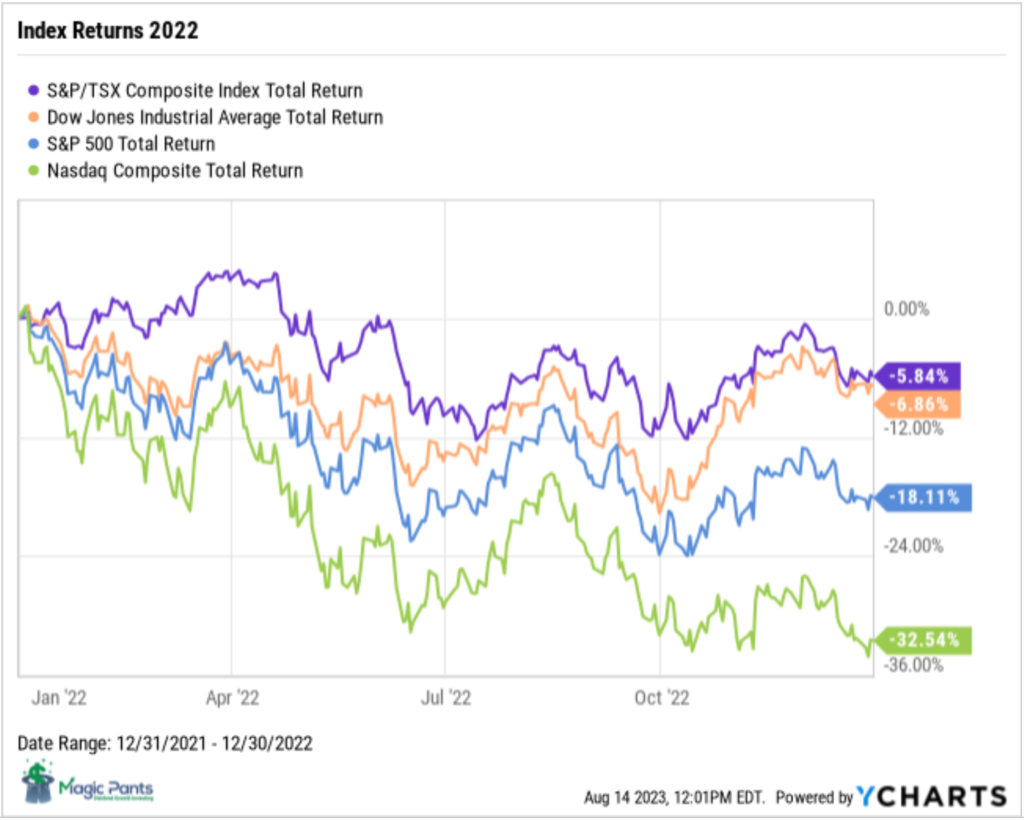
 

MP Market Review – August 11, 2023

Last updated by BM on August 14, 2023

Summary 

  • This is a weekly installment of our MP Market Review series, which provides updates on the financial markets and Canadian dividend growth companies we monitor on ‘The List’.
  • Last week, ‘The List’ was up with a YTD price return of +4.1% (capital). Dividend growth remained the same and is now at +8.4% YTD, highlighting growth in income over the past year.
  • Last week, no dividend increases from companies on ‘The List’.
  • Last week, eight earnings reports from companies on ‘The List’.
  • No companies on ‘The List’ are due to report earnings this week.
  • If you’re interested in creating your own dividend growth income portfolio, consider subscribing to our premium service, which grants you access to the MP Wealth-Builder Model Portfolio (CDN) and exclusive subscriber-only content.  Learn More         

Identifying companies whose dividend growth aligns closely with price growth can considerably enhance the predictability of future returns. Dividend growth investors know that the dividend drives the price in a predictable way, not the other way around. Metro Inc. (MRU-T) is another company on ‘The List’ that follows this dividend growth principle.

Introduction

“You have a pair of pants. In the left pocket, you have $100. You take $1 out of the left pocket and put it in the right pocket. You now have $101. There is no diminution of dollars in your left pocket. That is one magic pair of pants.”

This ‘magic pants’ analogy was from a Seeking Alpha article on dividend investing I read about a decade ago and was one of the catalysts for me to take a closer look at this type of investing and see if it truly was magical. 

After conducting additional research, I have shifted towards utilizing a dividend growth investing (DGI) strategy as my primary investment approach. While I maintain portfolios consisting of high-quality dividend growers from both the United States and Canada, I have opted to concentrate on Canadian (CDN) dividend growth companies in this blog. This is due to several reasons, including a smaller pool of DGI companies to track, a lack of coverage for the DGI strategy by the North American investment media, and a tendency for those who do cover DGI to narrowly focus on only a handful of sectors (Energy and Financials).

While ‘The List’ is not a portfolio in itself, it serves as an excellent initial reference for individuals seeking to diversify their investments and attain higher returns in the Canadian stock market. Through our blog, we provide weekly updates on ‘The List’ and offer valuable perspectives and real-life examples of the dividend growth investing strategy in practice. This helps readers gain a deeper understanding of how to implement and benefit from this investment approach.


DGI Thoughts

“The four most expensive words in the English language are ‘This time it’s different.’”

 – Sir John Templeton

The Q2 Earnings season is over for companies we follow on ‘The List’. Check out the earnings calendar here and see how each company performed against analyst expectations and the same quarter last year.

Over 50% of the companies we follow did not meet their Q2 comparable earnings from 2022! This should be a signal to investors that even the highest-quality companies are seeing the effects of higher interest rates and inflation. The economy is definitely starting to slow down.

On the flip side, some companies are doing quite well. They tend to be non-cyclical in nature and have pricing power built-in to their business models to offset the effects of inflation on the cost side. Think food retail and utilities.

The third quarter should be interesting. We will find out if the central banks will continue their fight against inflation and slow the economy even further or are they done, and earnings will start to recover. Either way, pay attention to the earnings numbers and take a few minutes to read the quarterly earnings releases below, especially the ‘Outlook’ sections. From this you will get a better sense if management is hinting of an earnings contraction in the quarter ahead or ‘will it be different this time’.

If you have not yet joined as a paid subscriber of the blog to receive DGI Alerts on the activity and content related to our model portfolio, it’s not too late. Click Here. 

Recent News 

Why the stellar performance of the magnificent seven makes a case for index investing (Globe & Mail)

https://www.theglobeandmail.com/investing/markets/inside-the-market/article-why-the-stellar-performance-of-the-magnificent-seven-makes-a-case-for/

“The so-called magnificent seven stocks were responsible for practically all of the gains in the S&P 500 index through the first half of the year. Widen the lens out to the entire world, and roughly 70 per cent of the net wealth created by stock markets globally was driven by this handful of tech behemoths.”

“This year makes an unusually strong case for a broad index approach, which may seem counterintuitive. Why would you want to be forced to own legions of losing stocks when the market rally is so heavily concentrated in a small core of elite names?”

Articles like this perpetuate the myth that index investing is the place to be right now. How soon we forget the market indexes in 2022!

Stop your active portfolio manager bashing. Skill does still matter (Globe & Mail)

https://www.theglobeandmail.com/investing/investment-ideas/article-active-investment-strategy-success/

“Funds that invest in concentrated portfolios and/or deviate significantly from benchmarks tend to outperform, according to recent academic studies.”

There is a lot of good information in this article. There is a lot of good information in this article. Dividend growth investing is a ‘value-oriented’ investing strategy as well. We only purchase our quality dividend growers when they are sensibly (value) priced.

Here are a few of my favorite quotes:

“One can earn risk-adjusted returns of up to 9 per cent a year with rudimentary analysis of the most commonly reported accounting information. Such abnormal profits are a result of fundamental analysis and taking advantage of market inefficiencies.”

“The value-investing process involves three steps. Initially, value investors screen stocks and form portfolios based on a number of metrics such as P/E, P/B, market cap, etc. and focus on stocks in the lowest ranked portfolio. This allows them to identify stocks that have desirable characteristics (i.e., low price vs. fundamentals) and, at the same time, reduce the number of stocks they will consider in depth. The stocks selected from the initial step are now valued to determine their intrinsic value using both asset based and cash-flow-based valuation approaches. Finally, they make a decision to invest only in stocks that are truly undervalued, namely stocks that meet the required margin of safety.”

“Slow economic growth around the world, particularly in China, as well as a slowdown in productivity, lower population growth, aging baby boomers, higher taxes, higher inflation/interest rates and lower government spending will lead to an increase in stock-market volatility. An expensive market will also contribute to rising volatility, both realized and expected.

In this environment, active managers, such as value investors, will shine.”

To receive breaking news about companies on ‘The List’ follow us on Twitter @MagicPants_DGI.

The List (2023)

Last updated by BM on August 11, 2023

The Magic Pants List contains 27 Canadian dividend growth stocks. ‘The List’ contains Canadian companies that have raised their dividend yearly for at least the last ten years and have a market cap of over a billion dollars. Below is each stock’s symbol, name, current yield, current price, price return year-to-date, current dividend, dividend growth year-to-date and current dividend growth streak. Companies on ‘The List’ are added or subtracted once a year, on January 1. After that, ‘The List’ is set for the next twelve months. Prices and dividends are updated weekly.

SYMBOL COMPANY YLD PRICE YTD % DIV YTD % STREAK
AQN-N Algonquin Power & Utilities 6.8% $7.48 11.1% $0.51 -29.0% 12
ATD-T Alimentation Couche-Tard Inc. 0.8% $69.73 15.9% $0.56 19.1% 13
BCE-T Bell Canada 6.7% $56.78 -5.7% $3.82 5.0% 14
BIP-N Brookfield Infrastructure Partners 4.4% $33.31 5.2% $1.44 6.3% 15
CCL-B-T CCL Industries 1.7% $61.99 6.8% $1.06 10.4% 21
CNR-T Canadian National Railway 2.0% $157.23 -3.5% $3.16 7.8% 27
CTC-A-T Canadian Tire 4.4% $156.82 7.0% $6.90 17.9% 12
CU-T Canadian Utilities Limited 5.6% $32.13 -13.0% $1.79 1.0% 51
DOL-T Dollarama Inc. 0.3% $85.60 7.2% $0.27 23.8% 12
EMA-T Emera 5.4% $51.57 -2.0% $2.76 3.0% 16
ENB-T Enbridge Inc. 7.2% $49.38 -7.4% $3.55 3.2% 27
ENGH-T Enghouse Systems Limited 3.0% $28.21 -21.0% $0.85 18.2% 16
FNV-N Franco Nevada 1.0% $142.84 3.4% $1.36 6.3% 15
FTS-T Fortis 4.1% $54.53 -1.5% $2.26 4.1% 49
IFC-T Intact Financial 2.2% $200.23 2.3% $4.40 10.0% 18
L-T Loblaws 1.5% $118.01 -1.9% $1.74 10.3% 11
MGA-N Magna 3.2% $57.25 -0.5% $1.84 2.2% 13
MRU-T Metro 1.7% $71.09 -5.8% $1.21 10.0% 28
RY-T Royal Bank of Canada 4.2% $127.57 -0.4% $5.34 7.7% 12
SJ-T Stella-Jones Inc. 1.4% $68.10 37.4% $0.92 15.0% 18
STN-T Stantec Inc. 0.9% $89.69 37.3% $0.77 8.5% 11
TD-T TD Bank 4.5% $86.26 -1.6% $3.84 7.9% 12
TFII-N TFI International 1.1% $132.49 32.3% $1.40 29.6% 12
TIH-T Toromont Industries 1.4% $115.87 18.6% $1.68 10.5% 33
TRP-T TC Energy Corp. 7.5% $49.33 -7.4% $3.69 3.4% 22
T-T Telus Corp. 6.0% $23.78 -9.7% $1.43 7.3% 19
WCN-N Waste Connections 0.7% $140.68 6.8% $1.02 7.4% 13
Averages 3.3% 4.1% 8.4% 19

Six Canadian stocks on ‘The List’ declare earnings and dividends in US dollars and are inter-listed on a US exchange in US dollars. The simplest way to display dividend and price metrics for these stocks is to show their US exchange symbols along with their US dividends and price. The stocks I am referring to have a -N at the end of their symbols. You can still buy their Canadian counterparts (-T), but your dividends will be converted into CDN dollars and will fluctuate based on the exchange rate.

Note: When the dividend and share price currency match, the calculation is straightforward. But it’s not so simple when the dividend is declared in one currency, and the share price is quoted in another. Dividing the former by the latter would produce a meaningless result because it’s a case of apples and oranges. To calculate the yield properly, you must express the dividend and share price in the same currency.

Performance of ‘The List’

Feel free to click on this link, ‘The List’ for a sortable version from our website.

Last week, ‘The List’ was up with a YTD price return of +4.1% (capital). Dividend growth remained the same and is now at +8.4% YTD, highlighting growth in income over the past year.

The best performers last week on ‘The List’ were Alimentation Couche-Tard Inc. (ATD-T), up +5.67%; Telus Corp. (T-T), up +3.53%; and Canadian Utilities Limited (CU-T), up +2.91%.

Canadian Tire (CTC-A-T) was the worst performer last week, down -12.27%.


Dividend Increases

“The growth of dividend paying ability is of significance in the determination of a stock’s quality, or general safety…”

– Arnold Bernhard (the founder of Value Line)

“As a dividend increase is a positive sign of a company’s financial strength, the safest purchase, after research, is a stock with a recent dividend increase.”

– Tom Connolly (the founder of dividendgrowth.ca)

Last week, no dividend increases from companies on ‘The List’.


Earnings Releases

Benjamin Graham once remarked that earnings are the principal factor driving stock prices.

Each quarter we will provide readers with weekly earnings updates of stocks on ‘The List’ during the calendar earnings season. 

The updated earnings calendar can be found here.

Earnings growth and dividend growth tend to go hand in hand, so this information can tell us a lot about the future dividend growth of our quality companies. Monitoring our dividend growers periodically is part of the process, and reading the quarterly earnings releases is a good place to start.

No earnings reports from companies on ‘The List’ this week

Last week, eight companies on ‘The List’ reported earnings.
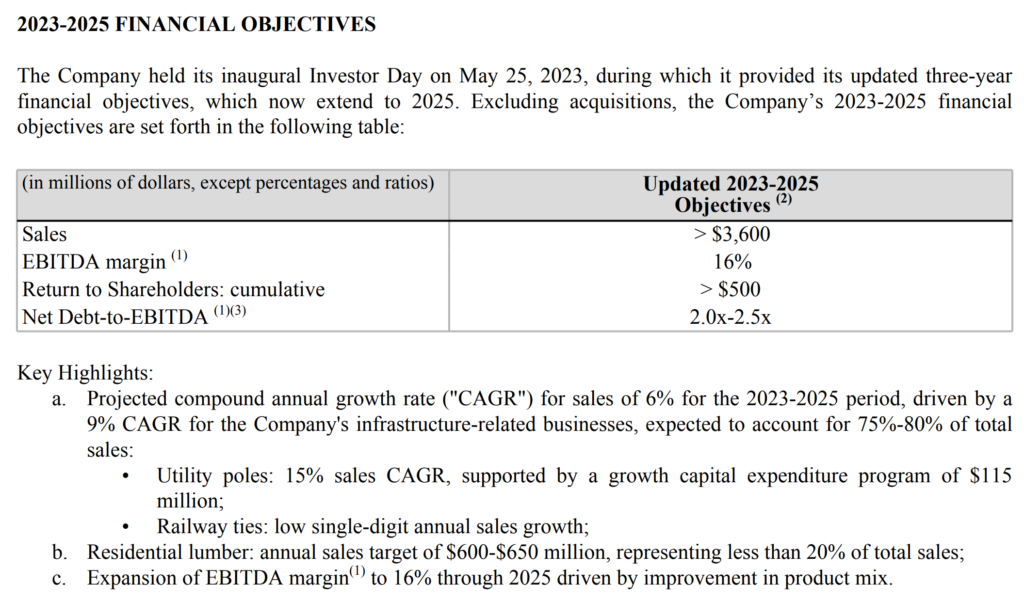
Franco Nevada (FNV-N) released its second-quarter fiscal 2023 results on Tuesday, August 8, 2023, after markets closed.

“Our portfolio continues to generate strong cash flows and high margins. The second quarter’s results benefited from our core assets returning to normal production and deliveries caught up from the disruptions in Q1. Revenue from our Diversified assets was impacted by lower oil, gas and iron ore prices compared to the relative highs of the prior year period. We expect Total GEOs for the year to be at the low end of our guidance range provided in March this year. We are looking forward to increased contributions from Cobre Panama, where the CP100 Expansion is on-track for year-end, and to contributions from royalties on several new mines. Franco-Nevada is debt-free and is growing its cash balances.”

– Paul Brink, Chief Executive Officer

Highlights:

  • In Q2 2023, we earned $329.9 million in revenue, down 6.4% from Q2 2022, as the impact of lower commodity prices for our Diversified assets more than offset the increase in revenue from our Precious Metal assets. With Cobre Panama and Antapaccay operating at full production levels following the temporary disruptions in early 2023, both assets generated strong deliveries in Q2 2023. Partly offsetting the impact of lower oil and gas prices, during the quarter, we received catch-up royalty payments of approximately $7.0 million related to new wells primarily at our Permian interests, which are not expected to reoccur.
  • Precious Metal revenue accounted for 78.6% of our revenue (64.8% gold, 10.7% silver, 3.1% PGM). Revenue was sourced 88.9% from the Americas (32.1% South America, 26.2% Central America & Mexico, 17.5% U.S. and 13.1% Canada).

Outlook:

Q2 Earnings Conference Call

Question: “Paul as you mentioned, you’re now targeting the lower end of the guidance range. If you kind of answered my question, but I just want to confirm. If I just look at your precious metals guidance, you’re actually tracking pretty well. So the fact that you’re targeting for total GEOs, the lower end. Is that really just due to lower sort of diversified prices, energy prices, iron ore prices? Or is that too simplistic of a way to look at it?

Answer: “You’re essentially correct. It’s — when we did our original guidance, the iron ore price we used was higher than what it’s averaged thus far in 2023 and what we’re using going forward, same with the energy prices. And so the other side, the gold price is higher than what we had in our original guidance. So you get a double impact on converting the non-gold revenue to GEOs, and that’s essentially the reason for guiding to the lower end.”

– Paul Brink, Chief Executive Officer

Source: (FNV-N) Q2-2023 Earnings Release


Metro (MRU-T) released its third-quarter fiscal 2023 results on Wednesday, August 9, 2023, before markets opened.

“We delivered solid results in the third quarter fueled by strong same-store sales and good operating leverage. With persistent food inflation, our teams did an excellent job to offer good value to our customers, resulting in market share gains and tonnage growth, driven by our discount food stores. Our loyalty program MOİ was successfully launched this quarter and we are pleased with the strong customer response so far. This enhanced program provides even more value to customers by offering multiple ways to earn and redeem points on food and pharmacy purchases in Québec. We are clearly disappointed with the current labour dispute in 27 of our Metro stores in the Greater Toronto Area given that we had reached a very good agreement that was unanimously recommended by union representatives. We look forward to a resolution and the re-opening of our stores as soon as possible, while ensuring the long-term competitiveness of our company.”

– Eric La Fleche, President and Chief Executive Officer

Highlights:

  • Sales of $6,427.5 million, up 9.6%
  • Food same-store sales up 9.4%
  • Pharmacy same-store sales up 5.9%
  • Net earnings of $346.7 million, up 26.1%, and adjusted net earnings of $314.8 million, up 10.9%
  • Fully diluted net earnings per share of $1.49, up 30.7%, and adjusted fully diluted net earnings per share of $1.35, up 14.4%

Outlook:

We remain focused on offering quality products at competitive prices as higher than normal inflation and market challenges persist. While we are not able to predict how the current macro-economic environment will evolve, we are seeing some moderation in food inflation, although it is still elevated compared to pre-pandemic levels. With this backdrop, we remain resilient and committed to providing the best value for our customers while delivering on our strategic priorities. In this respect, we look forward to the launch of our state-of-the-art, automated distribution center north of Montreal in the coming weeks.

Source: (MRU-T) Q3-2023 Earnings Release


Stella-Jones Inc. (SJ-T) released its second-quarter fiscal 2023 results on Wednesday, August 9, 2023, before markets opened.

“Stella-Jones is executing on its three-year growth plan with the achievement of another strong performance in the second quarter, reflecting the upward momentum generated by accelerating demand for our infrastructure-related products. Our second quarter results continued to benefit from higher pricing dynamics for utility poles, railway ties and industrial products, while residential lumber delivered sales in line with expectations.”

– Eric Vachon, President and Chief Executive Officer

Highlights:

  • Sales of $972 million, up 7%
  • 10% organic sales growth in infrastructure-related businesses
  • EBITDA of $175 million, or a margin of 18%, up from 17% in Q2 2022
  • Net income of $100 million, or $1.72 per share, up 14% from EPS in Q2 2022
  • Completed acquisitions and projects to seize growing utility pole demand

Outlook:

“In the second half of the year, we expect replenished railway tie inventory levels and ongoing capital projects for utility poles to facilitate anticipated volume gains, while our recent acquisitions of Balfour Pole Co. and Baldwin Pole and Pilings’ assets will further broaden the Company’s presence across North America. Our performance so far this year aligns with our plan to continue to grow our infrastructure-related businesses, increase profitability, as evidenced by the strong EBITDA margin generated in the second quarter, and to return capital and drive value for our shareholders. Managing capital projects, acquisitions and strong organic growth requires the resourcefulness and agility of our team of experts, and I am proud to recognize their invaluable contribution to our business.”

– Eric Vachon, President and Chief Executive Officer

Source: (SJ-T) Q2-2023 Earnings Release


Stantec (STN-T) released its second-quarter fiscal 2023 results on Wednesday, August 9, 2023, after markets closed.

“We continue to deliver significant growth in revenue and earnings driven by strong performance across all our regional and business operating units. As a result of our strong year-to-date results and our expectation of continued favorable market fundamentals for the remainder of the year, we are increasing our net revenue and adjusted earnings per share guidance for 2023.”

– Gord Johnston, President and Chief Executive Officer

Highlights:

Q2 2023 compared to Q2 2022

  • Net revenue increased 14.5% or $162.0 million to $1.3 billion, primarily driven by 11.2% organic growth. Double-digit organic growth was achieved in all regions and in Water, Environmental Services, and Energy & Resources businesses.
  • Project margin increased $91.3 million or 15.1% to $694.0 million. As a percentage of net revenue, project margin increased by 30 basis points to 54.3%.
  • Adjusted EBITDA increased $29.3 million or 15.7% to $216.0 million. Adjusted EBITDA margin increased by 20 basis points over Q2 2022 to 16.9%, despite a significant expense related to the revaluation of the Company’s LTIP, primarily due to strong share price appreciation in the quarter. Excluding the revaluation, adjusted EBITDA margin was 17.5%.
  • Net income increased 45.0%, or $27.3 million, to $88.0 million, and diluted EPS increased 43.6%, or $0.24, to $0.79, mainly due to strong net revenue growth, solid project margins, and lower administrative and marketing expenses as a percentage of net revenue.
  • Adjusted net income and adjusted diluted EPS achieved record highs in the quarter. Adjusted net income grew 18.1%, or $16.8 million, to $109.4 million, achieving 8.6% of net revenue (9.0% without the effect of the LTIP revaluation), and adjusted diluted EPS increased 19.3% to $0.99 ($1.04 without the effect of the LTIP revaluation).
  • Contract backlog increased to $6.6 billion at June 30, 2023, a record high reflecting 10.0% organic growth from December 31, 2022—with double-digit organic backlog growth in Stantec’s US and Canada operations as well as in Environmental Services and Water. Contract backlog represents approximately 13 months of work—an increase of one month from December 31, 2022.
  • Operating cash flows increased $35.4 million, with cash inflows of $31.0 million, reflecting strong revenue growth and operational performance. This compares to $4.4 million outflows in the comparative period, which resulted primarily from the Cardno financial system integration.
  • DSO1 was 81 days, consistent with December 31, 2022 and March 31, 2023.
  • On June 30, 2023, Stantec acquired Environmental Systems Design, Inc. (ESD), a 300-person firm headquartered in Chicago that provides building engineering services, specializing in mission critical and data center services.
  • Net debt to adjusted EBITDA (on a trailing twelve-month basis) at June 30, 2023 was 1.8x, remaining within Stantec’s internal target range of 1.0x to 2.0x, and reflecting the impact of funding the ESD acquisition on the last day of the reporting period.
  • On June 27, 2023, Stantec issued $250 million senior unsecured notes due June 27, 2030 that bear interest at a fixed rate of 5.393% per annum. These notes were assigned an investment-grade credit rating of BBB by DBRS Limited. Additionally, the Company entered into and fully drew upon an unsecured bilateral term credit facility of $100 million that matures on June 17, 2024. The proceeds of both the notes and new term facility were used to repay a portion of existing indebtedness on the revolving credit facility.

Outlook:

Stantec is revising and increasing certain targets contained within the Company’s 2023 guidance (provided on page M-10 in the 2022 Annual Report) based on the strength of the Company’s financial performance to date and the outlook for the balance of this year.

Stantec is raising its guidance for net revenue and adjusted diluted EPS growth and narrowing the target range for adjusted EBITDA as a percentage of net revenue.

Source: (STN-T) Q2-2023 Earnings Release


CCL Industries (CCL-B-T) released its second-quarter fiscal 2023 results on Wednesday, August 9, 2023, after markets closed.

“Solid second quarter results were held by slowing demand in parts of the economy as higher interest rates took hold impacting consumer spending patterns. Avery and Checkpoint both continued to post organic growth, but more than offset by a modest decline in the CCL Segment and the pass through of energy, freight and raw materials deflation at Innovia.”

– Geoffrey T. Martin, President and Chief Executive Officer

Highlights:

  • Net earnings decreased 4.6% to $155.9 million for the 2023 second quarter compared to $163.4 million for the 2022 second quarter. Basic and adjusted basic earnings per Class B share for the 2023 second quarter were $0.88 and $0.90, respectively, compared to basic and adjusted basic earnings per Class B share of $0.91 and $0.94, respectively, in the prior year second quarter. Foreign currency translation had a positive $0.05 per share impact on earnings.
  • Sales for the second quarter of 2023 increased 1.8% to $1,644.5 million, compared to $1,615.2 million for the second quarter of 2022, with an organic decline of 4.5% offset by acquisition related growth of 1.0% and a 5.3% positive impact from foreign currency translation.
  • Operating income for the second quarter of 2023 was $242.0 million compared to $247.8 million for the comparable quarter of 2022. Operating income for the 2022 second quarter included a $3.5 million non-cash acquisition accounting adjustment related to the acquired inventory from the Adelbras acquisition that was expensed in the Company’s cost of sales in the period. Foreign currency translation had a 5.8% positive impact on operating income for the comparable quarters.
  • The Company recorded an expense for restructuring and other items of $2.9 million, primarily attributable to reorganization charges at CCL Design and transaction costs associated with acquisitions completed in the current year compared to $3.2 million for reorganization costs in the 2022 second quarter.
  • Tax expense for the second quarter of 2023 was $47.7 million compared to $51.7 million in the prior year period. The effective tax rate for the 2023 second quarter was 24.0%, lower than the 24.4% for the 2022 second quarter due to a higher portion of the Company’s taxable income earned in lower tax jurisdictions.

CCL

  • Sales increased 3.1% to $995.5 million on 3.0% organic decline, offset by 0.3% acquisition contribution and 5.8% positive impact from foreign currency translation
  • Regional organic sales growth: low single digit in Europe and Latin America; North America and Asia Pacific declined low single digit and double digit, respectively
  • Operating income $144.0 million, down 7.0%, 14.5% operating margin down 150 bps
  • Label joint ventures added $0.03 earnings per Class B share

Avery

  • Sales increased 13.3% to $268.0 million on 2.6% organic growth, 5.6% acquisition contribution and 5.1% positive impact from foreign currency translation
  • Operating income $50.3 million, up 7.2%, 18.8% operating margin, down 100 bps

Checkpoint

  • Sales increased 6.8% to $210.5 million on organic growth of 3.3% and 3.5% positive impact from foreign currency translation
  • Operating income $28.1 million, up 24.3%, 13.3% operating margin, up 180 bps

Innovia

  • Sales decreased 21.2% to $170.5 million with 26.6% organic decline partially offset by 5.4% postive impact from foreign currency translation
  • Operating income $19.6 million, down 16.2%, 11.5% operating margin, up 70 bps

Outlook:

  • Core CCL business units’ face slower volume at many consumer packaged goods customers
  • CCL Design: expect modest improvement by Q4 as comps ease, computer industry demand slowly recovers and new business wins kick in
  • CCL Secure demand picture unchanged for second half
  • Avery solid, back to school replenishment orders the only unknown
  • Checkpoint: favorable as inflation recovery and RFID strength continue
  • Innovia volume expected to slowly recover in second half, inflation benign
  • FX tailwind to continue at current exchange rates

Source: (CCL-B-T) Q2-2023 Earnings Release


Algonquin Power & Utilities (AQN-T) released its second-quarter fiscal 2023 results on Thursday, August 10, 2023, before markets opened.

“While our second quarter 2023 results were negatively impacted by unfavourable weather, we remain focused on our growth outlook and long-term success.” 

– Chris Huskilson, Interim Chief Executive Officer

Highlights:

  • Revenue of $627.9 million, an increase of 1%;
  • Adjusted EBITDA1 of $277.7 million, a decrease of 4%;
  • Adjusted Net Earnings of $56.2 million, a decrease of 49%; and
  • Adjusted Net Earnings per common share of $0.08, a decrease of 50%, in each case on a year-over-year basis.

Outlook:

Algonquin Brief: Chris Huskilson Appointed Interim CEO, Succeeding Arun Banskota; Board Commencing Search for a Permanent CEO

Following a strategic review, the company determined that focusing on the regulated business and going forward with a sale of the renewable business is the best path forward.

The company expects to sell the renewables business as a whole rather than in parts as management sees significant value in the development pipeline.

“We believe the value of our assets is not fully realized in our current structure. We therefore determined that focusing on our regulated business going forward and pursuing a sale of the renewables business is the best path forward for AQN.”

– Chris Huskilson, Interim Chief Executive Officer

Source: (AQN-N) Q2-2023 Earnings Release


Canadian Tire (CTC-A-T) released its second-quarter fiscal 2023 results on Thursday, August 10, 2023, before markets opened.

“As inflation persisted and rate hikes continued, consumer demand for discretionary goods softened, particularly in the latter half of the quarter, and Canadians shifted to more essentials within our multi-category assortment. Loyalty sales continue to outperform non-member spend, driving an increase in loyalty penetration. During this time of macroeconomic uncertainty, Triangle Rewards remains our most important driver in delivering value for our customers.”

– Greg Hicks, President and Chief Executive Officer

Highlights:

  • Consolidated comparable sales were up 0.1%, following strong growth of 5.0% in Q2 2022
  • Normalized diluted Earnings Per Share (“EPS”) was $3.08, compared to $3.11 in Q2 2022; Diluted EPS was $1.76, compared to $2.43 in Q2 2022
  • Loyalty sales as a percentage of retail sales up 80 bps in the quarter

Outlook:

The current macroeconomic environment and consumer demand differ significantly from the Company’s expectations when it set out its strategy and 2022-2025 financial aspirations (average annual Comparable sales growth, Retail Return on Invested Capital and Diluted EPS) at its Investor Day in March 2022. Since early 2022, the cumulative effect of increasing inflationary pressure and higher interest rates on consumer spend and financing costs, along with higher inventory costs, has significantly impacted the Company’s ability to deliver against its previous expectations. Given the slower pacing of growth, and the noticeable slowdown in retail sales during the second quarter of 2023, the Company is withdrawing its previously disclosed financial aspirations at this time.

Despite the near-term consumer demand environment, the Company remains committed to pursuing the strategic objectives that demonstrate its long-term vision and build on its strong market position. The Company also continues to invest in the strategic initiatives outlined in the Better Connected strategy to grow earnings, and continues to make progress on the key initiatives highlighted above, to solidify CTC’s brand and competitive positioning in Canada over the long-term.

Source: (CTC-A-T) Q2-2023 Earnings Release


Emera Inc. (EMA-T) released its second-quarter fiscal 2023 results on Friday, August 11, 2023, before markets opened.

“Our team continues to execute well on our proven strategy and despite the continued headwinds of high interest rates and overall inflationary pressures, we are driving solid results for customers and shareholders. As economic growth continues in our service territories, we remain focused on meeting growing demand and achieving a balanced energy transition that delivers increasingly clean energy while maintaining grid reliability and continues to consider cost impacts for customers, all while providing predictable, reliable earnings and cash flow growth for our shareholders.”

– Scott Balfour, President and Chief Executive Officer

Highlights:

  • Quarterly adjusted EPS increased $0.01 to $0.60 compared to $0.59 in Q2 2022. Quarterly reported net income per common share increased $0.35 to $0.10 in Q2 2023 compared to a net loss per common share of $(0.25) in Q2 2022 due to lower mark-to-market (“MTM”) losses.
  • Year-to-date, adjusted EPS increased $0.07 or 5% to $1.58 compared to $1.51 in 2022. Year-to-date reported EPS increased by $1.05 to $2.17 from $1.12 in 2022 due to MTM gains in 2023 compared to MTM losses in 2022.
  • Adjusted EPS contributions from our regulated utilities increased 8% for the quarter and 3% year-to-date primarily driven by rate supported capital investments and continued customer growth partially offset by higher interest expense and less favourable weather. On a consolidated basis these increases were partially offset by higher corporate interest expense and lower contributions from Emera Energy Services (“EES”) during the quarter.
  • On track to deploy $2.8 billion in capital in 2023 with $1.4 billion invested in the first half of the year.

Outlook:

There have been no material changes in Emera’s business overview and outlook from the Company’s 2022 annual MD&A other than the updates as disclosed below. Emera’s year-to-date results have been impacted by macroeconomic conditions, specifically higher interest rates as well as other impacts of inflation. These macroeconomic conditions are likely to continue for the near term. For information on general economic risk, including interest rate and inflation risk, refer to the “Enterprise Risk and Risk Management – General Economic Risk” in Emera’s 2022 annual MD&A. For details on Emera’s reportable segments, refer to note 1 of the Q2 2023 unaudited condensed consolidated interim financial statements.

Source: (EMA-T) Q2-2023 Earnings Release


We buy quality individual dividend growth stocks when they are sensibly priced and hold for the growing income.