
MP Market Review – March 27, 2026
Last updated by BM on March 31, 2026
Summary
This is not a stock-picking newsletter.
It’s a behind-the-scenes look at how a dividend growth portfolio is built, maintained, and improved over time.
Welcome to this week’s MP Market Review. Each week, we track the Canadian dividend growth companies on The List, our curated watchlist of businesses designed to produce rising income. While we also publish a U.S. edition monthly, Canada remains our training ground.
Our objective is simple: grow dividend income by 7–10%+ annually while delivering capital appreciation that matches or exceeds the TSX Composite in Canada and the S&P 500 for our U.S. investors over a full market cycle.
What you’re about to read isn’t theory. It’s the real-time application of a dividend growth strategy using real money, with a clear objective: growing income first and letting capital growth follow.
Markets generate a lot of noise. We ignore most of it.
Instead, we track a small set of metrics that tell us whether our dividend growth strategy is working in real time. No forecasts. No opinions. Just results.
Here they are:
- Dividend income from The List: +6.4% year-to-date
- Capital value: -1.6% year-to-date
- Dividend announcements last week: One
- Earnings reports last week: One
- Earnings reports this week: One
DGI Clipboard
“The market falls by 10% once about every two years. Every six years, the market’s going to have a 25% decline. The market goes down sometimes. If you’re not ready for that, you shouldn’t own stocks.”
– Peter Lynch

Everyone Has Buffett’s Playbook. Very Few Have His Results.
When Warren Buffett was asked why so few investors have been able to replicate his success, despite him openly sharing his methods, his answer may surprise you.
Here is what he said:
“The philosophy either takes immediately or it doesn’t at all. The reason gets down to temperament. People want to make money fast, but it doesn’t happen that way. Graham’s philosophy doesn’t promise enough for many people. You don’t know when it will happen, but you just wait for the fat pitches within your circle of competence. It’s not as exciting as guessing whether the stock price will go up the next day. Most investors in internet companies didn’t know the market cap. They were buying because they thought the stock would move, but if you asked them to write, ‘I would buy XYZ company for 6 billion because,’ they wouldn’t get halfway through the sentence. It’s the classic tortoise versus hare, bound to work over time.”
Why most investors fail and we win
Every investor says they want long-term success.
Very few are willing to behave in a way that produces it.
When Warren Buffett was asked why so few people have been able to replicate his approach, despite him sharing it openly for decades, his answer had nothing to do with intelligence.
It came down to temperament.
That is the part most investors ignore.
And it is exactly why dividend growth investing works so well.
The strategy is simple. The execution is not.
Dividend growth investing is not complicated.
We:
buy high-quality businesses
at sensible prices
that grow their dividends over time
and hold them
That’s it.
No forecasts.
No predictions.
No guessing.
But here is the catch.
You have to stick with it.
And that is where most investors fail.
Most investors want speed. We want durability.
Buffett said it clearly.
People want to make money fast.
That is why they chase:
- hot sectors
- trending stocks
- short-term price moves
They are not thinking like owners.
They are thinking like traders.
In our strategy, we do the opposite.
We focus on:
- earnings growth
- income (dividend) growth
- long-term value
It is slower.
It is quieter.
But it works.
Because real wealth is built through compounding, not excitement.
The real edge is temperament
Let’s be honest.
This strategy can feel uncomfortable at times.
You will:
- watch prices fall
- hold positions that go nowhere for months
- buy when sentiment is negative
We have lived it.
- buying Toronto-Dominion Bank during weakness
- adding to Canadian National Railway on pullbacks
- building a position in TC Energy when sentiment was poor
- holding Nexterra Energy after a 20% decline right after purchase
None of those decisions felt good in the moment.
But they were correct.
Because they were grounded in process, not emotion.
This is the difference.
Successful investors are not fearless.
They are disciplined.
Waiting is a strategy
Buffett talks about waiting for “fat pitches.”
This is Dividend Yield Theory in action.
We are not swinging every day.
We wait for:
- higher-than-normal historical yields
- price weakness in quality companies
- valuation to return to sensible levels
That is how we use:
- The List
- The Timely Ten
- the three-dot rule
Patience is not passive. It is selective.
Know what you own or don’t own it
Buffett made another critical point.
Most investors cannot explain why they own what they own.
They buy because:
- the price is moving
- someone recommended it
- it “feels” like a good idea
That is speculation.
We stay in areas we understand:
- banks
- railroads
- pipelines
- utilities
- essential service businesses
These are not exciting.
They are predictable.
Predictability is what allows dividends to grow.
And dividend growth is what drives:
earnings → income → price
The tortoise wins
This is not a race to the next trade.
It is a process.
We are building:
- a growing income stream
- that increases every year
- regardless of what the market is doing
While others:
- panic
- chase
- react
We collect.
And reinvest.
And repeat.
That is how the income snowball forms.
Slow at first.
Then unstoppable.
This is why it works
Buffett’s message is simple.
The strategy is available to everyone.
The results are not.
Because most investors:
- lack patience
- chase excitement
- abandon discipline
Dividend growth investing removes those variables.
It replaces them with:
- process
- consistency
- time
And over a full market cycle, that is what wins.
Takeaway
Buffett is not giving you a stock tip.
He is warning you.
Most people will fail at investing for one reason:
They don’t have the temperament to stick with it.
So the real question is not:
“What should I buy?”
It is:
“Can I stay disciplined long enough for this to work?”
Because if you can…
You don’t need to be smarter than the market.
You just need to be more patient than the average investor.
Build income first.
Let capital follow.
Looking for a helping hand in the market? Members of Magic Pants Dividend Growth Investing get exclusive ideas and guidance to navigate any climate.
The Magic Pants model portfolios (Canadian and American) are real-money dividend growth portfolios funded with actual capital and executed in live accounts. Every position shown is owned, sized, and tracked in real time using our disciplined DGI process.
Become a paid subscriber, and I’ll show you exactly how I do it. In addition, gain full access to this post and exclusive, subscriber-only content. We do the work; you stay in control.
DGI Scorecard
The Magic Pants 2026 list (The List) includes 26 Canadian dividend growth stocks and our new American watchlist (The List-USA) contains 28 companies. Here are the criteria to be considered a candidate on our watchlists:
- Dividend growth streak: 10 years or more.
- Market cap: Minimum one billion dollars.
- Diversification: Limit of five companies per sector, preferably two per industry.
- Cyclicality: Exclude REITs and pure-play energy companies due to high cyclicality.
Based on these criteria, companies are added or removed from ‘The List’ annually on January 1. Prices and dividends are updated weekly.
‘The List’ is not a portfolio but a coaching tool that helps us think about ideas and risk manage our model portfolio. We own some but not all the companies on ‘The List’. In other words, we might want to buy these companies when valuation looks attractive.
Our newsletter provides readers with a comprehensive insight into the implementation and advantages of our Canadian dividend growth investing strategy. This evidence-based, unbiased approach empowers DIY investors to outperform both actively managed dividend funds and passively managed indexes and dividend ETFs over longer-term horizons.
Performance of ‘The List’
The dividend growth of The List was up last week, with an average YTD increase of 6.4% (income).
The price of The List was up last week and now stands at -1.6% YTD (capital).
Top Performers Last Week:
- Stella-Jones Inc. (SJ-T), up +6.21%.
- TFI International (TFII-N), up +5.63%.
- Franco Nevada (FNV-N), up +5.13%.
Worst Performer Last Week:
- Dollarama Inc. (DOL-T), down -7.68%.
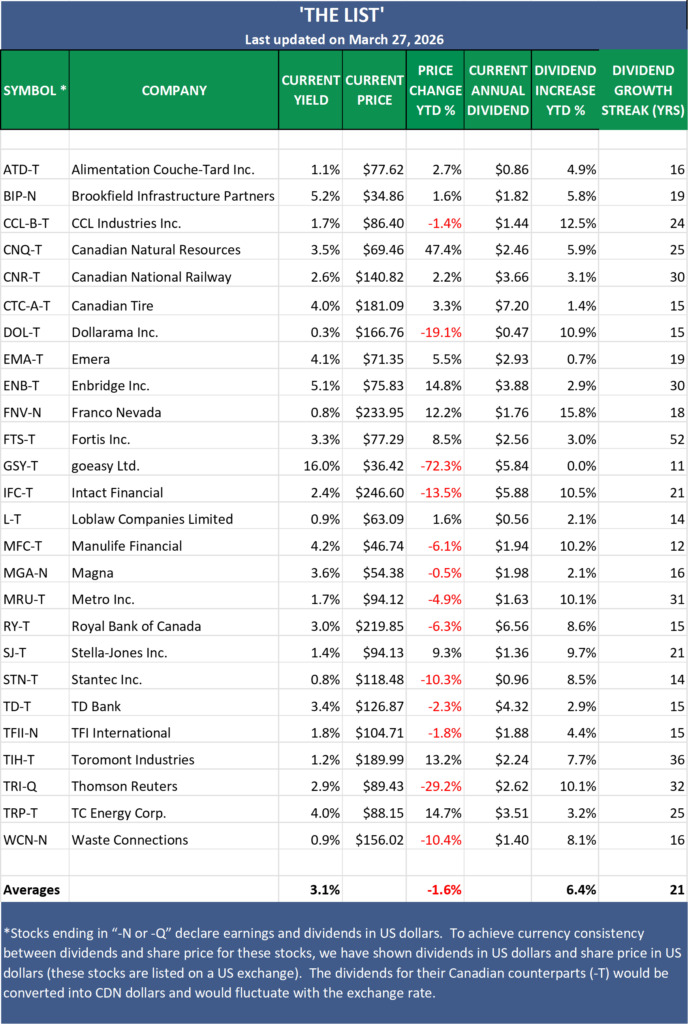
Note: Stocks ending in “-N or -Q” declare earnings and dividends in US dollars. To achieve currency consistency between dividends and share price for these stocks, we have shown dividends in US dollars and share price in US dollars (these stocks are listed on a US exchange). The dividends for their Canadian counterparts (-T) would be converted into CDN dollars and would fluctuate with the exchange rate.
PAID subscribers enjoy full access to our enhanced weekly newsletter, premium content, and easy-to-follow trade alerts so they can build DGI portfolios alongside ours. This service provides the resources to develop your DGI business plan confidently. We do the work; you stay in control!
It truly is the subscription that pays dividends!
The greatest investment you can make is in yourself. Are you ready to take that step?
For more articles and the full newsletter, check us out on magicpants.substack.com.