“You have a pair of pants. In the left pocket, you have $100. You take $1 out of the left pocket and put in the right pocket. You now have $101. There is no diminution of dollars in your left pocket. That is one magic pair of pants.”

MP Market Review – February 27, 2026

Last updated by BM on March 3, 2026

Summary


This is not a stock-picking newsletter.

It’s a behind-the-scenes look at how a dividend growth portfolio is built, maintained, and improved over time.

Welcome to this week’s MP Market Review. Each week, we track the Canadian dividend growth companies on The List, our curated watchlist of businesses designed to produce rising income. While we also publish a U.S. edition monthly, Canada remains our training ground.

Our objective is simple: grow dividend income by 7–10%+ annually while delivering capital appreciation that matches or exceeds the TSX Composite in Canada and the S&P 500 for our U.S. investors over a full market cycle.

What you’re about to read isn’t theory. It’s the real-time application of a dividend growth strategy using real money, with a clear objective: growing income first and letting capital growth follow.

Markets generate a lot of noise. We ignore most of it.

Instead, we track a small set of metrics that tell us whether our dividend growth strategy is working in real time. No forecasts. No opinions. Just results.

Here they are:

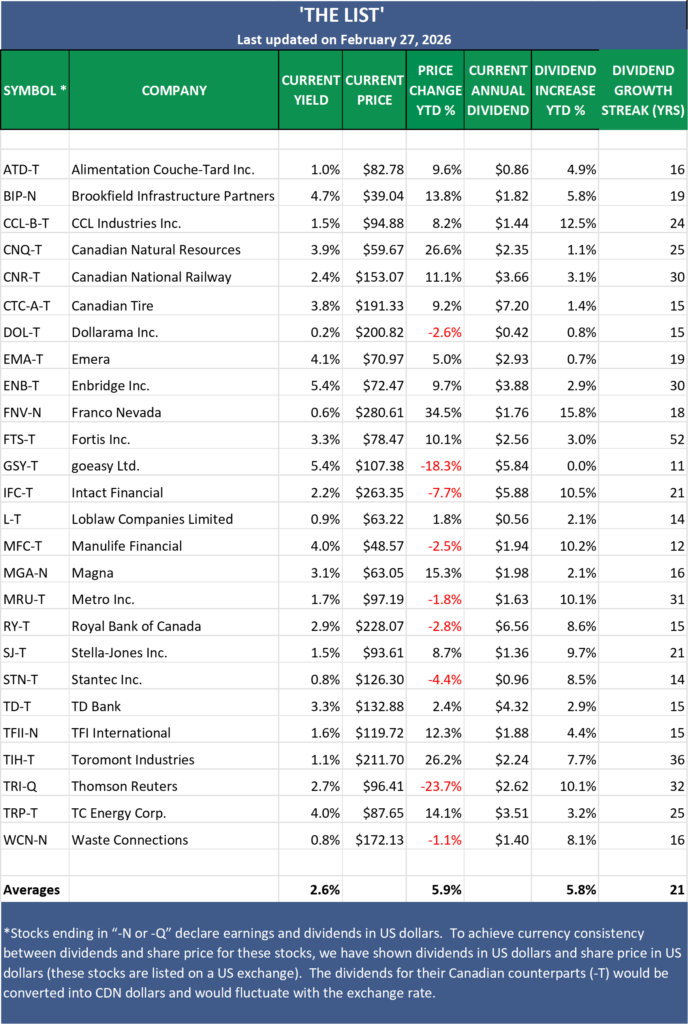
  • Dividend income from The List: +5.8% year-to-date
  • Capital value: +5.9% year-to-date
  • Dividend announcements last week: Three
  • Earnings reports last week: Seven
  • Earnings reports this week: One

DGI Clipboard


“Try not to notice the market itself or prices as much this year. Cash flow is wealth.”

– Tom Connolly
Intro


One of the most powerful ideas in long-term investing is simple: build your income stream before you need it. Dividend growth investing turns that idea into a disciplined, repeatable strategy. Rather than waiting until retirement to generate cash flow, you steadily accumulate ownership in high-quality businesses that raise their dividends year after year. Over time, that rising income becomes the engine that funds financial freedom.

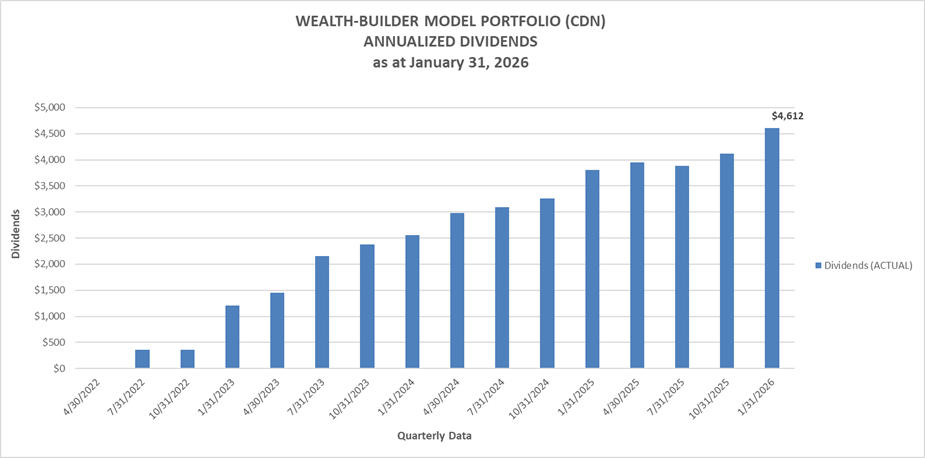
In our recent Portfolio Letter, the Wealth-Builder Model Portfolio (CDN) demonstrates how this works in practice. Since inception in May 2022, annualized dividend income has increased every year, reaching $4,612 by January 31, 2026. This progress did not come from chasing high yield. It came from consistent investment in companies with durable earnings, strong balance sheets, and proven dividend growth. As dividends increased and new capital was deployed, the portfolio’s income stream compounded.
The Outcome

This is the core insight of dividend growth investing: income is not dependent on market prices on any given day. Once shares are owned, dividends continue to be paid and typically grow regardless of short-term volatility. Over time, the income stream becomes more predictable, more durable, and more valuable.

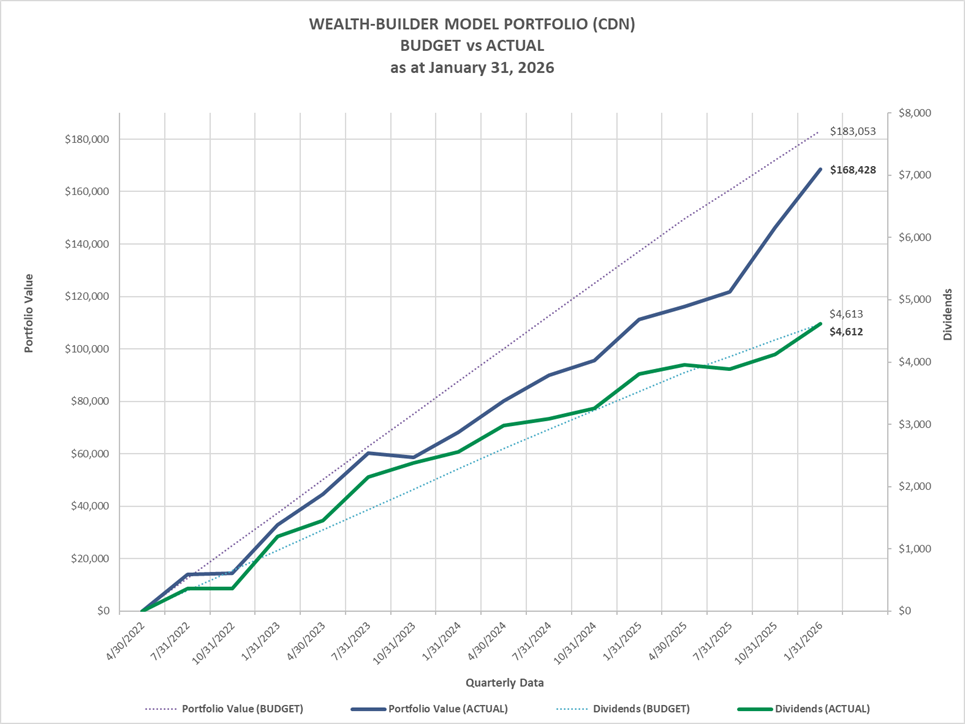
The budget-versus-actual comparison highlights another important principle: compounding progress. Portfolio value and dividends have tracked closely with the original plan, occasionally exceeding expectations. By early 2026, actual dividends of $4,612 were aligned with the projected path, while portfolio value reached $168,428 versus a planned $183,053. The modest shortfall is primarily timing related. Additional dividend growth in the coming quarters and the deployment of remaining capital should narrow this gap.
This distinction matters. Many investors focus on price returns and postpone income planning until retirement approaches. Dividend growth investing reverses that order. Income is built first and capital appreciation follows. As company earnings expand, dividends rise. As dividends rise, share prices tend to follow. Income growth and capital growth reinforce each other, creating a widening margin of safety on the original capital invested.

Starting early magnifies this effect. Each year of reinvested dividends and new contributions increases the base from which future income grows. By the time income is needed, the portfolio is already producing meaningful cash flow. Instead of selling assets to fund spending, investors can increasingly live off dividends alone. That transition from accumulation to self-funded income is the essence of financial independence.

Takeaway


Warren Buffett captured this idea perfectly: “If you don’t find a way to make money while you sleep, you will work until you die.” Dividend growth investing is exactly that. You build ownership in exceptional businesses that keep paying you more each year. Long before retirement arrives, your portfolio begins doing the work for you.

That is how freedom is funded. Not at retirement, but years before it.

The Magic Pants model portfolios (Canadian and American) are real-money dividend growth portfolios funded with actual capital and executed in live accounts. Every position shown is owned, sized, and tracked in real time using our disciplined DGI process.

Become a paid subscriber, and I’ll show you exactly how I do it. In addition, gain full access to this post and exclusive, subscriber-only content. We do the work; you stay in control.

DGI Scorecard


The Magic Pants 2026 list (The List) includes 26 Canadian dividend growth stocks and our new American watchlist (The List-USA) contains 28 companies. Here are the criteria to be considered a candidate on our watchlists:

  1. Dividend growth streak: 10 years or more.
  2. Market cap: Minimum one billion dollars.
  3. Diversification: Limit of five companies per sector, preferably two per industry.
  4. Cyclicality: Exclude REITs and pure-play energy companies due to high cyclicality.

Based on these criteria, companies are added or removed from ‘The List’ annually on January 1. Prices and dividends are updated weekly.

‘The List’ is not a portfolio but a coaching tool that helps us think about ideas and risk manage our model portfolio. We own some but not all the companies on ‘The List’. In other words, we might want to buy these companies when valuation looks attractive.

Our newsletter provides readers with a comprehensive insight into the implementation and advantages of our Canadian dividend growth investing strategy. This evidence-based, unbiased approach empowers DIY investors to outperform both actively managed dividend funds and passively managed indexes and dividend ETFs over longer-term horizons.

Performance of ‘The List’


Dividend growth of The List was up last week with an average increase YTD of +5.8% (income).

The price of The List went up last week and now stands at +5.9% YTD (capital).

Top Performers Last Week: 

  • Thomson Reuters (TRI-Q), up +15.88%.
  • Franco Nevada (FNV-N), up +7.76%.
  • CCL Industries Inc. (CCL-B-T), up +7.62%.

Worst Performer Last Week: 

  • goeasy Ltd. (GSY-T), down -8.61%.

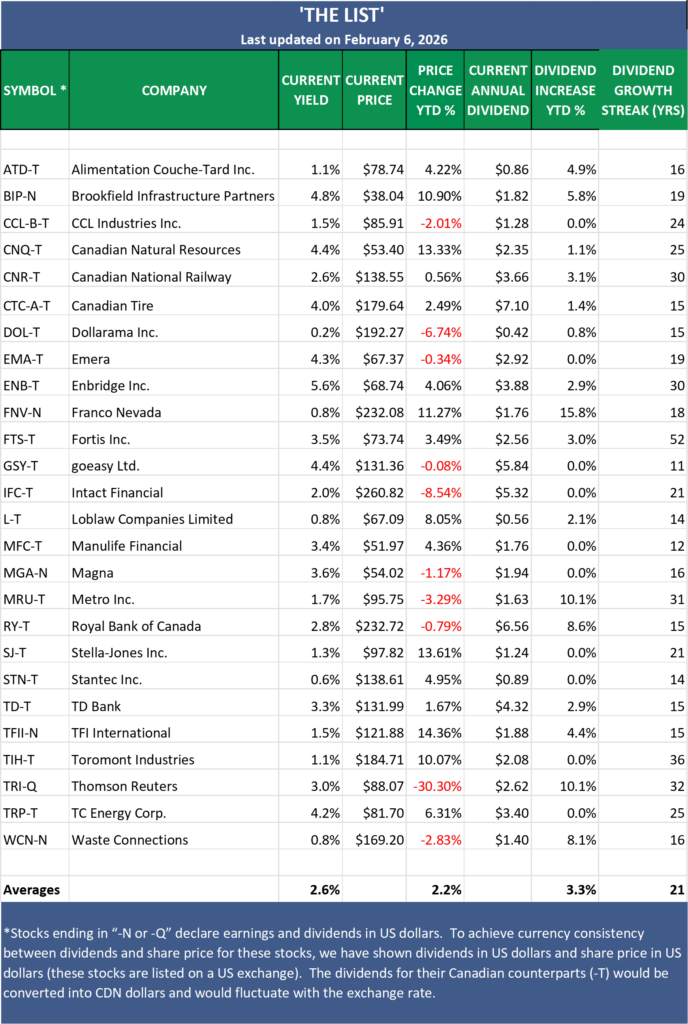
Note: Stocks ending in “-N or -Q” declare earnings and dividends in US dollars. To achieve currency consistency between dividends and share price for these stocks, we have shown dividends in US dollars and share price in US dollars (these stocks are listed on a US exchange). The dividends for their Canadian counterparts (-T) would be converted into CDN dollars and would fluctuate with the exchange rate.

PAID subscribers enjoy full access to our enhanced weekly newsletter, premium content, and easy-to-follow trade alerts so they can build DGI portfolios alongside ours. This service provides the resources to develop your DGI business plan confidently. We do the work; you stay in control!

It truly is the subscription that pays dividends!

The greatest investment you can make is in yourself. Are you ready to take that step? 

For more articles and the full newsletter, check us out on magicpants.substack.com.
MP Market Review – February 20, 2026

Last updated by BM on February 24, 2026

Summary


This is not a stock-picking newsletter.

It’s a behind-the-scenes look at how a dividend growth portfolio is built, maintained, and improved over time.

Welcome to this week’s MP Market Review. Each week, we track the Canadian dividend growth companies on The List, our curated watchlist of businesses designed to produce rising income. While we also publish a U.S. edition monthly, Canada remains our training ground.

Our objective is simple: grow dividend income by 7–10%+ annually while delivering capital appreciation that matches or exceeds the TSX Composite in Canada and the S&P 500 for our U.S. investors over a full market cycle.

What you’re about to read isn’t theory. It’s the real-time application of a dividend growth strategy using real money, with a clear objective: growing income first and letting capital growth follow.

Markets generate a lot of noise. We ignore most of it.

Instead, we track a small set of metrics that tell us whether our dividend growth strategy is working in real time. No forecasts. No opinions. Just results.

Here they are:

  • Dividend income from The List: +4.6% year-to-date
  • Capital value: +4.6% year-to-date
  • Dividend announcements last week: None
  • Earnings reports last week: Two
  • Earnings reports this week: Seven

DGI Clipboard


“How much of your retirement pot can you safely spend every year without dipping into capital?” was the title of a column in Forbes from June 17, 1996 (the year and month I retired from teaching business).

My answer: all of it and more as our pot keeps growing.”

Tom Connolly, legendary Canadian dividend growth investor

Dividend Investing vs. Dividend Growth Investing
Intro

Same word. Completely different outcomes.

Investors often use the terms dividend investing and dividend growth investing as if they mean the same thing. They don’t.

Both involve owning companies that pay dividends. But the strategy, the mindset, and most importantly the long-term results are very different.

Understanding this distinction is one of the biggest turning points for new income investors.

Dividend Investing: Income Today

Traditional dividend investing focuses on current yield.

The goal is simple: generate the highest possible income right now.

Investors following this approach typically buy:

  • High-yield stocks
  • Utilities and telecoms with slow growth
  • REITs and income vehicles
  • Mature or stagnant businesses

The portfolio often looks attractive at first glance. A 6%–8% yield feels powerful. Cash flow starts immediately.

But there is a trade-off.

High current yield usually means low growth. Sometimes no growth at all.

Over time, inflation erodes purchasing power, dividends stagnate, and share prices often go nowhere. In weaker businesses, both income and capital can eventually decline.

Dividend investing gives you income today.
But it rarely builds wealth tomorrow.

Dividend Growth Investing: Income That Compounds

Dividend growth investing flips the focus from yield to growth of income.

Instead of asking, “What pays the most now?” the question becomes: “Which companies will pay far more in the future?”

Dividend growth investors target:

  • Companies with durable competitive advantages
  • Consistent earnings growth
  • Strong balance sheets
  • Long histories of raising dividends

These businesses often start with moderate yields of 1%–3%. That can feel unimpressive to yield-focused investors.

But the power is in the growth.

If a company increases its dividend 7%–10% annually, the income doubles roughly every 7–10 years. Over decades, this creates what we call bondified equities: stocks that eventually yield far more on your original cost than any fixed-income investment ever could.

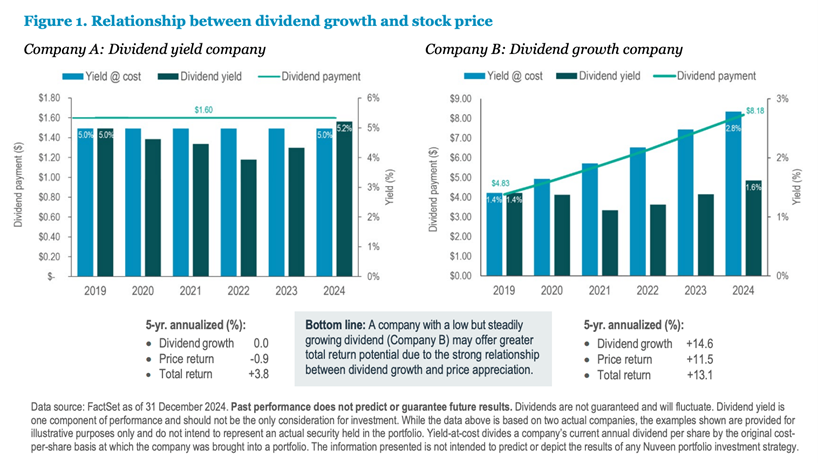
The Critical Link: Dividend Growth and Price Appreciation

Here is the part many investors miss.

Dividend growth and price appreciation are not separate outcomes.
They are the same economic force expressed in two ways.

Dividends come from earnings.
Rising dividends require rising earnings.
And rising earnings ultimately drive rising share prices.

Over long periods, stock prices follow dividend growth because both reflect the growth of the underlying business.

This is why the best dividend growth companies show a powerful pattern:

Earnings up → Dividend up → Price up

Not every year. Markets fluctuate. Valuations expand and contract.

But over full cycles, dividend growth is one of the most reliable predictors of long-term capital appreciation.

In other words:

Dividend growth investing is not just an income strategy.
It is a total return strategy driven by business growth.

The Outcome Difference

A high-yield dividend portfolio may deliver strong income early but often plateaus.

A dividend growth portfolio starts slower but compounds relentlessly:

  • Income rises every year
  • Purchasing power increases
  • Capital value grows alongside dividends
  • Financial flexibility expands over time

Eventually, the income from a dividend growth portfolio often surpasses what high-yield investing could ever sustain.

Takeaway


Dividend investing asks: How much can I earn today?
Dividend growth investing asks: How much can this grow for decades?

One focuses on yield.
The other focuses on compounding.

And in long-term investing, compounding wins.

The Magic Pants model portfolios (Canadian and American) are real-money dividend growth portfolios funded with actual capital and executed in live accounts. Every position shown is owned, sized, and tracked in real time using our disciplined DGI process.

Become a paid subscriber, and I’ll show you exactly how I do it. In addition, gain full access to this post and exclusive, subscriber-only content. We do the work; you stay in control.

DGI Scorecard


The Magic Pants 2026 list (The List) includes 26 Canadian dividend growth stocks and our new American watchlist (The List-USA) contains 28 companies. Here are the criteria to be considered a candidate on our watchlists:

  1. Dividend growth streak: 10 years or more.
  2. Market cap: Minimum one billion dollars.
  3. Diversification: Limit of five companies per sector, preferably two per industry.
  4. Cyclicality: Exclude REITs and pure-play energy companies due to high cyclicality.

Based on these criteria, companies are added or removed from ‘The List’ annually on January 1. Prices and dividends are updated weekly.

‘The List’ is not a portfolio but a coaching tool that helps us think about ideas and risk manage our model portfolio. We own some but not all the companies on ‘The List’. In other words, we might want to buy these companies when valuation looks attractive.

Our newsletter provides readers with a comprehensive insight into the implementation and advantages of our Canadian dividend growth investing strategy. This evidence-based, unbiased approach empowers DIY investors to outperform both actively managed dividend funds and passively managed indexes and dividend ETFs over longer-term horizons.

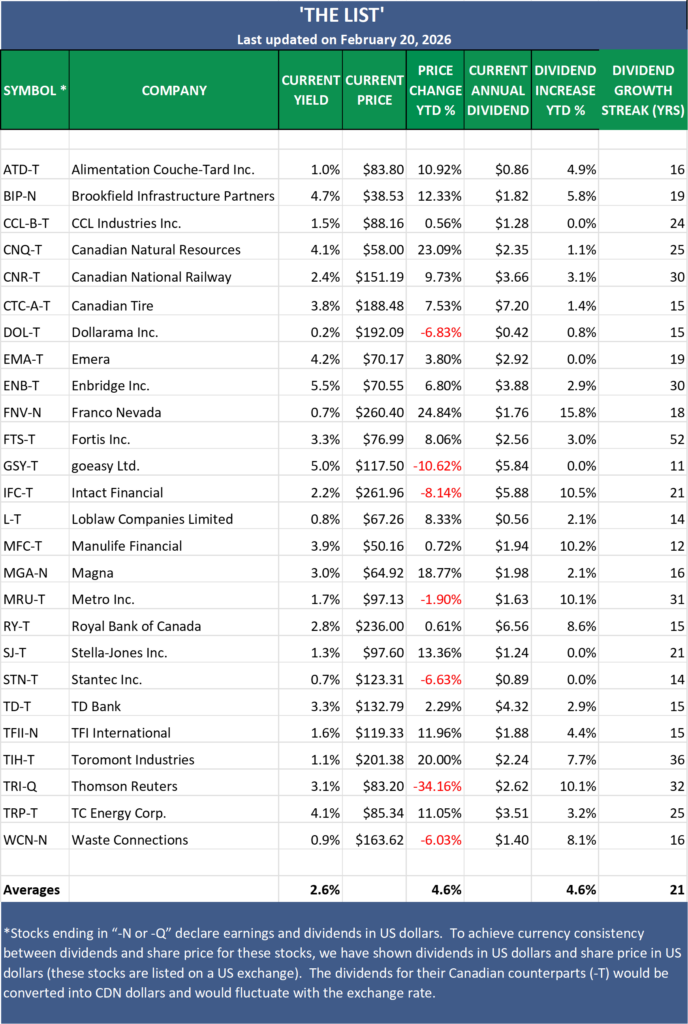
Performance of ‘The List’


Dividend growth of The List stayed the same with an average increase YTD of +4.6% (income). These are dividends announced late last year and early in 2026.

The price of The List went up last week and now stands at +4.6% YTD (capital).

Top Performers Last Week: 

  • Canadian Tire (CTC-A-T), up +4.97%.
  • Canadian Natural Resources (CNQ-T), up +4.92%.
  • Stantec Inc. (STN-T), up +3.97%.

Worst Performer Last Week: 

  • Magna (MGA-N), down -5.54%.

Note: Stocks ending in “-N or -Q” declare earnings and dividends in US dollars. To achieve currency consistency between dividends and share price for these stocks, we have shown dividends in US dollars and share price in US dollars (these stocks are listed on a US exchange). The dividends for their Canadian counterparts (-T) would be converted into CDN dollars and would fluctuate with the exchange rate.

PAID subscribers enjoy full access to our enhanced weekly newsletter, premium content, and easy-to-follow trade alerts so they can build DGI portfolios alongside ours. This service provides the resources to develop your DGI business plan confidently. We do the work; you stay in control!

It truly is the subscription that pays dividends!

The greatest investment you can make is in yourself. Are you ready to take that step? 

For more articles and the full newsletter, check us out on magicpants.substack.com.
MP Market Review – February 13, 2026

Last updated by BM on February 17, 2026

Summary


This is not a stock-picking newsletter.

It’s a behind-the-scenes look at how a dividend growth portfolio is built, maintained, and improved over time.

Welcome to this week’s MP Market Review. Each week, we track the Canadian dividend growth companies on The List, our curated watchlist of businesses designed to produce rising income. While we also publish a U.S. edition monthly, Canada remains our training ground.

Our objective is simple: grow dividend income by 7–10%+ annually while delivering capital appreciation that matches or exceeds the TSX Composite in Canada and the S&P 500 for our U.S. investors over a full market cycle.

What you’re about to read isn’t theory. It’s the real-time application of a dividend growth strategy using real money, with a clear objective: growing income first and letting capital growth follow.

Markets generate a lot of noise. We ignore most of it.

Instead, we track a small set of metrics that tell us whether our dividend growth strategy is working in real time. No forecasts. No opinions. Just results.

Here they are:

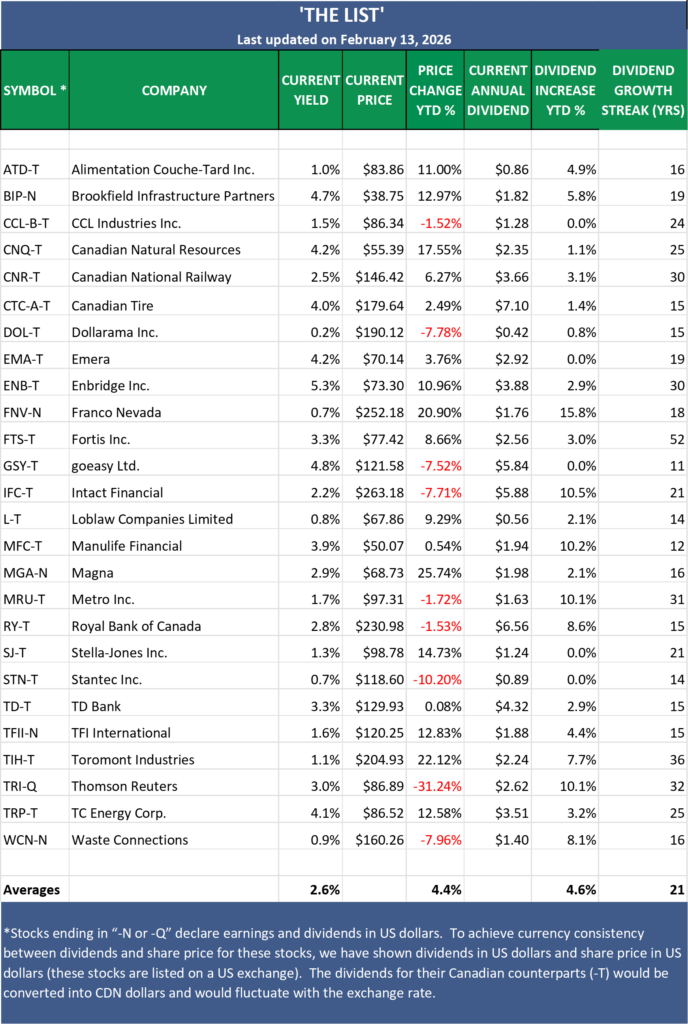
  • Dividend income from The List: +4.6% year-to-date
  • Capital value: +4.4% year-to-date
  • Dividend announcements last week: Five
  • Earnings reports last week: Eight
  • Earnings reports this week: Two

DGI Clipboard


“Current yield, using its own historic yield as a guide, is, in my view, a fine valuation measure.”

— Tom Connolly

Patience Paid: Timely Ten Winners and New Entrants
Intro


Our Timely Ten lists remain the fastest way to spot potential value opportunities, which explains why they continue to be the most-read articles every month.

Timely Ten – Canada

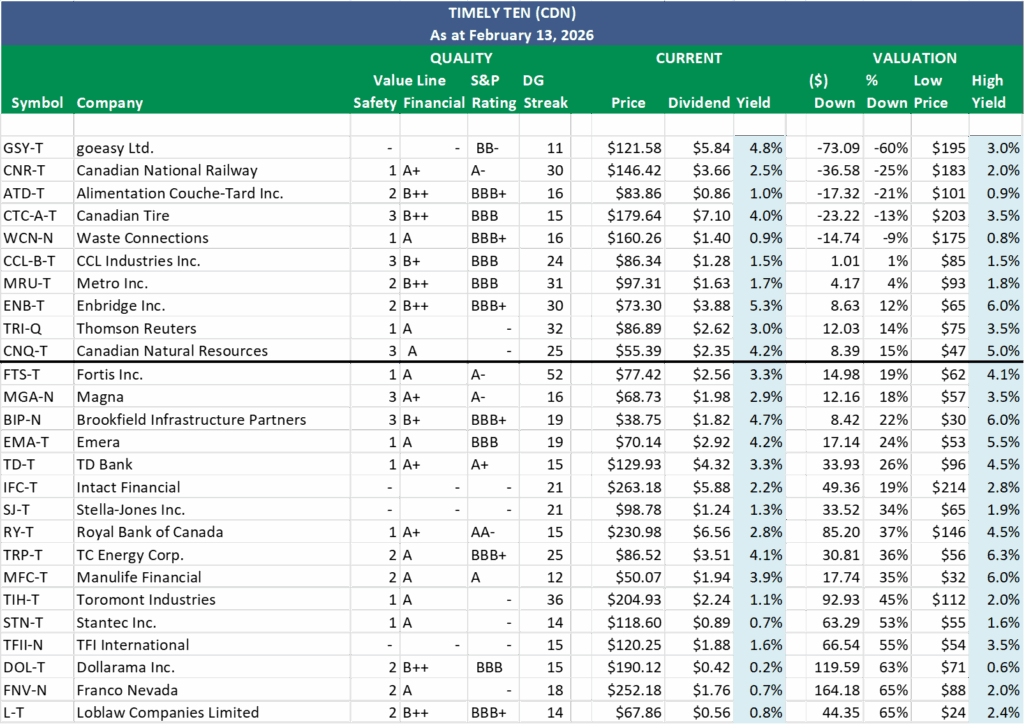
Typically, movement up and down the Timely Ten is gradual. Candidates often sit on the list for months before valuation becomes the catalyst and the stock finally moves. Not last month. Two names repriced dramatically in under 30 days.

Magna is the clearest example. It spent nearly two years in the top ten with little movement. Then a strong earnings report hit and the stock surged 27%, falling from #6 last month to #12 today. Moves like this are rare, but they remind us of a core truth: quality companies cannot stay undervalued forever. Magna’s cyclical business adds an element of timing, which is why we built positions in 2023 and again in 2025. When the market finally caught up last week, we were already there collecting a rising dividend. We never know when valuation will normalize, but patience plus dividend growth makes the wait pay.

At the opposite extreme was Thomson Reuters. The business remains strong: recurring revenue, strong free cash flow, and durable dividend growth. What changed was sentiment. The market has pulled software and information services into the AI disruption narrative, and TRI’s valuation compressed faster than expected. The stock’s jump up the Timely Ten from #21 to #9 in one month got our full attention and triggered our second DGI Alert. Unlike Magna’s surge, this was a valuation reset moving in our favor.

Timely Ten – United States

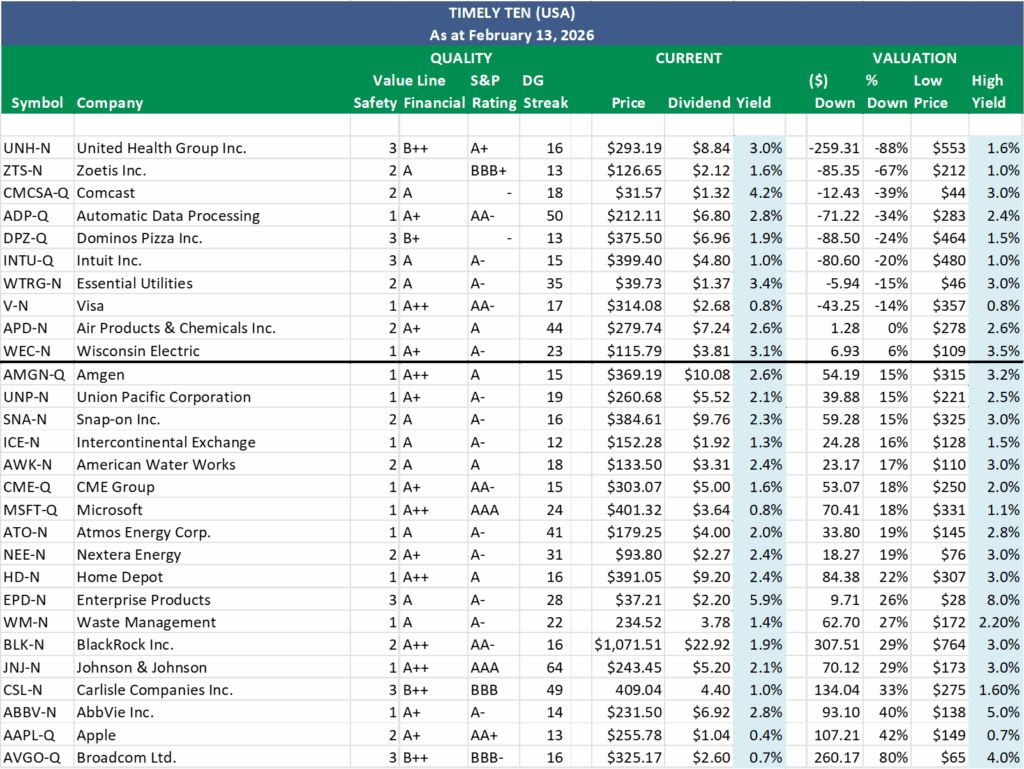
Union Pacific appears to be following Magna’s path. After a long stretch of undervaluation, it has moved out of the Timely Ten and now sits at #12 on our U.S. list. Railroads remain core infrastructure businesses with durable dividend and price growth over full cycles. We have waited patiently for this repricing, and it now looks close.

Automatic Data Processing and Intuit are now firmly embedded in the U.S. Timely Ten after price weakness last month. Intuit’s jump from #20 to #6 mirrors Thomson Reuters in Canada. The market is broadly derating software right now, and high-quality franchises are being marked down with the rest.

One more notable move: Microsoft. The stock climbed from #24 to #17 on the Timely Ten after its recent pullback. It is rare for one of the world’s highest-quality companies to even approach our undervalued range. We used the opportunity to initiate a position in the U.S. model portfolio. When elite businesses briefly go on sale, we act.

As always, the Timely Ten is not a call to action on its own, but a disciplined starting point for deeper research and patient capital deployment.

Here’s a recap on how we select our Timely Ten:

Step three in our process involves monitoring our quality dividend growers regularly, which can become quite challenging depending on the number of companies we track. Fortunately, we rely on ‘The List’ instead of the vast array of stocks in the index, which streamlines our task. Nevertheless, we continually seek methods to enhance our efficiency. Through dividend yield theory, we’ve discovered an approach that has proven remarkably effective in aiding us with our efforts over the years.

Dividend yield theory is a simple and intuitive approach to valuing dividend growth stocks. It suggests that the dividend yield of quality dividend growth stocks tends to revert to the mean over time, assuming that the underlying business model remains stable. In practical terms, if a stock pays a dividend yield above its ten-year average annual yield, its price will likely increase to return the yield to its historical average. Knowing that price and yield go in opposite directions, this theory helps us find stocks poised for a favourable price correction.

We have pre-screened our candidates using the criteria we initially laid out in building our watchlists. This helps us considerably narrow the universe of investable stocks.

  1. Dividend growth streak: 10 years or more.
  2. Market cap: Minimum one billion dollars.
  3. Diversification: Limit of five companies per sector, preferably two per industry.
  4. Cyclicality: Exclude REITs and pure-play energy companies due to high cyclicality.

Next, we rank our Canadian and American watchlists based on how far each stock’s price is below its fair value (Low Price), as determined by dividend yield theory. To find fair value, divide the current dividend (Dividend) by the stock’s historical high yield (High Yield).

Since price and yield move in opposite directions, a lower price results in a higher yield, and vice versa. The ten companies above the thick black line have a current price (Price) below fair value (Low Price). Put simply, these stocks have a current dividend yield higher than their historically high yield. According to dividend yield theory, these companies are sensibly priced and have the highest probability of a price increase in the short term. These are our Timely Ten.

Takeaway


History shows the Timely Ten is fertile ground for finding attractive entry points into high-quality dividend growers. Whether or not you act on the names, the list serves its purpose: to surface opportunities when quality meets value.

When making investment decisions, always prioritize a company’s ‘quality’ over a ‘sensible price’. For more details on our quality indicators, download our Free Guide to Finding Quality Dividend Growth Stocks here.

The Magic Pants model portfolios (Canadian and American) are real-money dividend growth portfolios funded with actual capital and executed in live accounts. Every position shown is owned, sized, and tracked in real time using our disciplined DGI process.

Become a paid subscriber, and I’ll show you exactly how I do it. In addition, gain full access to this post and exclusive, subscriber-only content. We do the work; you stay in control.

DGI Scorecard


The Magic Pants 2026 list (The List) includes 26 Canadian dividend growth stocks and our new American watchlist (The List-USA) contains 28 companies. Here are the criteria to be considered a candidate on our watchlists:

  1. Dividend growth streak: 10 years or more.
  2. Market cap: Minimum one billion dollars.
  3. Diversification: Limit of five companies per sector, preferably two per industry.
  4. Cyclicality: Exclude REITs and pure-play energy companies due to high cyclicality.

Based on these criteria, companies are added or removed from ‘The List’ annually on January 1. Prices and dividends are updated weekly.

‘The List’ is not a portfolio but a coaching tool that helps us think about ideas and risk manage our model portfolio. We own some but not all the companies on ‘The List’. In other words, we might want to buy these companies when valuation looks attractive.

Our newsletter provides readers with a comprehensive insight into the implementation and advantages of our Canadian dividend growth investing strategy. This evidence-based, unbiased approach empowers DIY investors to outperform both actively managed dividend funds and passively managed indexes and dividend ETFs over longer-term horizons.

Performance of ‘The List’


Dividend growth of The List continued to climb with an average increase YTD of +4.6% (income). These are dividends announced late last year and early in 2026.

The price of The List went up last week and now stands at +4.4% YTD (capital).

Top Performers Last Week: 

  • Magna (MGA-N), up +27.23%.
  • Toromont Industries (TIH-T), up +10.95%.
  • Franco Nevada (FNV-N), up +8.66%.

Worst Performer Last Week: 

  • Stantec Inc. (STN-T), down -14.44%.

Note: Stocks ending in “-N or -Q” declare earnings and dividends in US dollars. To achieve currency consistency between dividends and share price for these stocks, we have shown dividends in US dollars and share price in US dollars (these stocks are listed on a US exchange). The dividends for their Canadian counterparts (-T) would be converted into CDN dollars and would fluctuate with the exchange rate.

PAID subscribers enjoy full access to our enhanced weekly newsletter, premium content, and easy-to-follow trade alerts so they can build DGI portfolios alongside ours. This service provides the resources to develop your DGI business plan confidently. We do the work; you stay in control!

It truly is the subscription that pays dividends!

The greatest investment you can make is in yourself. Are you ready to take that step? 

For more articles and the full newsletter, check us out on magicpants.substack.com.
MP Market Review – February 6, 2026

Last updated by BM on February 10, 2026

Summary


This is not a stock-picking newsletter.

It’s a behind-the-scenes look at how a dividend growth portfolio is built, maintained, and improved over time.

Welcome to this week’s MP Market Review. Each week, we track the Canadian dividend growth companies on The List, our curated watchlist of businesses designed to produce rising income. While we also publish a U.S. edition monthly, Canada remains our training ground.

Our objective is simple: grow dividend income by 7–10%+ annually while delivering capital appreciation that matches or exceeds the TSX Composite in Canada and the S&P 500 for our U.S. investors over a full market cycle.

What you’re about to read isn’t theory. It’s the real-time application of a dividend growth strategy using real money, with a clear objective: growing income first and letting capital growth follow.

Markets generate a lot of noise. We ignore most of it.

Instead, we track a small set of metrics that tell us whether our dividend growth strategy is working in real time. No forecasts. No opinions. Just results.

Here they are:

  • Dividend income from The List: +3.3% year-to-date
  • Capital value: +2.2% year-to-date
  • Dividend announcements last week: One
  • Earnings reports last week: One
  • Earnings reports this week: Eight

DGI Clipboard


“I don’t know where we are going, but I know exactly how to get there.”

-Boyd Varty

A Beginner’s Guide to Building a Dividend Growth Portfolio
Intro


How We Build Portfolios

Dividend growth investing works best when it is treated as a process, not a prediction. Every portfolio we manage is built using the same repeatable framework designed to prioritize quality, discipline, and long-term income growth.

This article outlines exactly how we do it. 

Step 1: Start With a Curated Candidate List

Every holding begins on a carefully curated candidate list. This list is not static. Companies move on and off as fundamentals, valuations, and dividend policies evolve.

Each candidate is evaluated on:

  • Business quality and durability
  • Financial strength and balance sheet health
  • Dividend history, sustainability, and growth potential
  • Long-term earnings visibility

Only companies that meet our quality standards are eligible for inclusion. 

Step 2: Assign Quality Ratings and Categories

Once a company qualifies, it is assigned a quality rating and placed into one of two categories: Core or Non-Core. 

Core holdings are essential businesses with durable competitive advantages, consistent cash flow, and shareholder-friendly dividend policies. These companies form the backbone of the portfolio and are expected to deliver reliable income growth across full market cycles. 

Non-Core holdings are typically smaller or faster-growing businesses that enhance overall dividend growth. They offer higher upside potential but tend to carry more variability than Core holdings.

This classification determines how much capital we are willing to allocate. 

Step 3: Define Position Size Before Capital Is Deployed

Position sizing is decided before any trade is made. This removes emotion from the process and enforces discipline.

  • Maximum position size
    • Core holdings: up to 8%
    • Non Core holdings: up to 5%

These limits allow us to hold approximately 15 to 20 high-quality companies while maintaining meaningful concentration in our strongest ideas.

The goal is not diversification for its own sake. The goal is owning the best businesses at sensible weights. 

Step 4: Use Minimum Position Sizes to Stay Invested

Minimum position sizes are just as important as maximums.

Our minimum position size, for our Canadian portfolio, ranges from 1% to 4%, depending on category.

This approach serves two purposes:

  • It prevents overexposure when valuation or near-term fundamentals are less favorable
  • It ensures we maintain exposure to high-quality businesses we want to own long term

Once a company meets our standards, we stay invested and build positions deliberately over time as opportunities improve. 

Step 5: Adjust, Not React

The portfolio is monitored continuously, but changes are made deliberately. Charts, ratings, and categories may be updated throughout the year as new information becomes available.

Nothing here is fixed forever. The framework is consistent, but the inputs evolve.

Always refer to the “Last Updated” date on any portfolio chart or list for the most current view. 

Transparency for Paid Subscribers

Paid subscribers receive DGI Alerts whenever we initiate or add to a position in the model portfolio.

Each alert includes:

  • The execution price
  • The recommended position size
  • The rationale behind the decision

This allows subscribers to follow the process in real time and apply the same discipline to their own portfolios.

Takeaway


This is not about chasing returns or timing markets.

It is about owning high-quality businesses, sizing positions intelligently, and letting rising dividends do the heavy lifting over time.

Think like an owner.

Build deliberately.

Let income growth lead.

Become a paid partner, and I’ll show you exactly how I do it. With real money. In real stocks. In addition, gain full access to this post and exclusive, subscriber-only content. We do the work; you stay in control. Subscribe today and take your dividend growth investing to the next level!

DGI Scorecard


The Magic Pants 2026 list (The List) includes 26 Canadian dividend growth stocks and our new American watchlist (The List-USA) contains 28 companies. Here are the criteria to be considered a candidate on our watchlists:

  1. Dividend growth streak: 10 years or more.
  2. Market cap: Minimum one billion dollars.
  3. Diversification: Limit of five companies per sector, preferably two per industry.
  4. Cyclicality: Exclude REITs and pure-play energy companies due to high cyclicality.

Based on these criteria, companies are added or removed from ‘The List’ annually on January 1. Prices and dividends are updated weekly.

‘The List’ is not a portfolio but a coaching tool that helps us think about ideas and risk manage our model portfolio. We own some but not all the companies on ‘The List’. In other words, we might want to buy these companies when valuation looks attractive.

Our newsletter provides readers with a comprehensive insight into the implementation and advantages of our Canadian dividend growth investing strategy. This evidence-based, unbiased approach empowers DIY investors to outperform both actively managed dividend funds and passively managed indexes and dividend ETFs over longer-term horizons.

Performance of ‘The List’


Dividend growth of The List continued to climb with an average increase YTD of +3.3% (income). These are dividends announced late last year and early in 2026.

The price of The List went up last week and now stands at +2.2% YTD (capital).

Top Performers Last Week: 

  • TFI International (TFII-N), up +13.32%.
  • Alimentation Couche-Tard Inc. (ATD-T), up +11.15%.
  • Loblaw Companies Limited (L-T), up +9.5%.

Worst Performer Last Week: 

  • Thomson Reuters (TRI-Q), down -20.39%.

Note: Stocks ending in “-N or -Q” declare earnings and dividends in US dollars. To achieve currency consistency between dividends and share price for these stocks, we have shown dividends in US dollars and share price in US dollars (these stocks are listed on a US exchange). The dividends for their Canadian counterparts (-T) would be converted into CDN dollars and would fluctuate with the exchange rate.

PAID subscribers enjoy full access to our enhanced weekly newsletter, premium content, and easy-to-follow trade alerts so they can build DGI portfolios alongside ours. This service provides the resources to develop your DGI business plan confidently. We do the work; you stay in control!

It truly is the subscription that pays dividends!

The greatest investment you can make is in yourself. Are you ready to take that step? 

For more articles and the full newsletter, check us out on magicpants.substack.com.

We buy quality individual dividend growth stocks when they are sensibly priced and hold for the growing income.