MP Market Review – July 18, 2025
Last updated by BM on July 22, 2025
Summary
Welcome to this week’s MP Market Review – your go-to source for insights and updates on the Canadian dividend growth companies we track on The List! While we’ve expanded our watchlists to include U.S. companies The List-USA, our Canadian lineup remains the cornerstone of our coaching approach.
Don’t miss out on exclusive newsletters and premium content that will help you sharpen your investing strategy. Explore it all at magicpants.substack.com.
Your journey to dividend growth mastery starts here – let’s dive in!
- Last week, dividend growth stayed the same with an average return of +6.9% YTD (income).
- Last week, the price of The List was up from the previous week with an average return of +9.0% YTD (capital).
- Last week, there were no dividend announcements from companies on The List.
- Last week, there were no earnings reports from companies on The List.
- This week, three from The List will report on earnings.
DGI Clipboard
“Dividend growth is the hidden magic in plain sight. We hold because after ten years, our yield is at least 5%, on average 7% and often about 10%.”
– Tom Connolly
Why Price Doesn’t Matter (Most of the Time)

Intro
The only time price matters is when we buy and when we sell.
One of the things I enjoy most about writing my own blog is that it often leads to conversations with other seasoned investors. Because I do things a bit differently, I frequently find myself explaining what I do and why I’m so passionate about dividend growth investing (DGI).
Sometimes that passion can come across as a belief that DGI is the only valid approach. While I’ve used several different strategies over the years, I keep returning to DGI because, outside of index investing, it is one of the simplest and most passive strategies to learn. It also offers the satisfaction of active participation in the stock market, allowing investors to benefit from long-term market growth while keeping things straightforward. Even better, it has the potential to outperform the indexes on a total return basis, which many active strategies struggle to achieve.
As I explained to a seasoned retail investor last week, DGI is ultimately about growing your dividend income over time. While quality companies in our portfolios often appreciate in value, capital gains are not our primary focus. I know this may sound counterintuitive, especially if you’ve been taught that stock investing is all about price appreciation. I could tell the gentleman I was speaking with found this perspective a bit confusing.
But here is the key: if your dividend income continues to grow, it will not be long before your yield on cost (dividend return) surpasses the historical total returns of the broader market. Capital appreciation becomes the bonus, not the goal.
With dividend growth investing, our income increases every year, often by 7 to 10 percent, simply by holding high-quality companies. Over time, this compounding effect becomes substantial. The challenge for most investors is not the strategy itself; it is behavior. Many lack the patience to let the process play out or they sell out during periods of volatility.
Another common mistake is shifting to fixed-income products with age. These may seem safer, but their returns are often eroded by taxes and inflation, which can ultimately diminish purchasing power.
Knowing that we are often our own worst enemy when it comes to investing, I focus my coaching on timelines of a decade or less. If you are unable to commit to and follow a ten-year plan, you may want to reconsider managing your own investments.
The chart below, our 7 x 10 Test, illustrates how long it takes for the dividend yields of our quality companies to reach 7 percent, a figure that happens to match the historical annualized return of the stock market over the past 25 years.
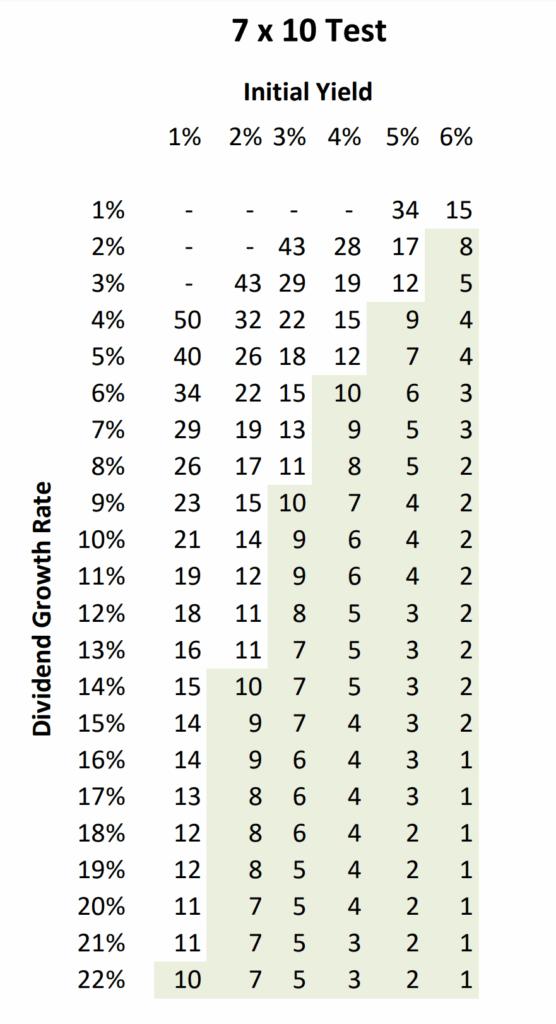
The numbers in the chart show how many years it will take you to earn a 7% dividend return.
The highlighted area shows combinations of starting yield and dividend growth rates that can get you to a 7% dividend return in a decade or under. For example, starting with a 3% yield and 9% annual dividend growth, you’ll reach a 7% dividend return in ten years. Likewise, a 4% starting yield with 6% growth gets you there in the same timeframe.
Takeaway
It’s not hard to find quality companies in both our Canadian and American watchlists that offer a compelling mix of starting yield and consistent dividend growth. Reaching a 7% dividend return in under a decade is entirely achievable. When you factor in the added benefit of capital appreciation, it’s easy to see why dividend growth investing continues to win over long-term investors.
Become a paid partner, and I’ll show you exactly how I do it. With real money. In real stocks. In addition, gain full access to this post and exclusive, subscriber-only content. We do the work; you stay in control. Subscribe today and take your dividend growth investing to the next level!
DGI Scorecard
The List (2025)
The Magic Pants 2025 list includes 29 Canadian dividend growth stocks. Here are the criteria to be considered a candidate on ‘The List’:
- Dividend growth streak: 10 years or more.
- Market cap: Minimum one billion dollars.
- Diversification: Limit of five companies per sector, preferably two per industry.
- Cyclicality: Exclude REITs and pure-play energy companies due to high cyclicality.
Based on these criteria, companies are added or removed from ‘The List’ annually on January 1. Prices and dividends are updated weekly.
‘The List’ is not a portfolio but a coaching tool that helps us think about ideas and risk manage our model portfolio. We own some but not all the companies on ‘The List’. In other words, we might want to buy these companies when valuation looks attractive.
Our newsletter provides readers with a comprehensive insight into the implementation and advantages of our Canadian dividend growth investing strategy. This evidence-based, unbiased approach empowers DIY investors to outperform both actively managed dividend funds and passively managed indexes and dividend ETFs over longer-term horizons.
Performance of ‘The List’
Last week, dividend growth stayed the same, with an average return of +6.9% YTD (income).
The price of ‘The List’ was up from the previous week, with an average YTD return of +9.0% (capital).
Even though prices may fluctuate, the dependable growth in our income does not. Stay the course. You will be happy you did.
Last week’s best performers on ‘The List’ were Alimentation Couche-Tard Inc. (ATD-T), up +9.91%.; Thomson Reuters (TRI-Q), up +5.08%; and Enghouse Systems Limited (ENGH-T) up +2.09%.
Canadian National Railway (CNR-T) was the worst performer last week, down -5.09%.
| SYMBOL | COMPANY | YLD | PRICE | YTD % | DIV | YTD % | STREAK |
|---|---|---|---|---|---|---|---|
| ATD-T | Alimentation Couche-Tard Inc. | 1.0% | $75.43 | -4.58% | $0.78 | 8.3% | 15 |
| BCE-T | Bell Canada | 8.8% | $32.50 | -3.04% | $2.87 | -28.1% | 16 |
| BIP-N | Brookfield Infrastructure Partners | 5.3% | $32.40 | 1.69% | $1.72 | 6.2% | 17 |
| CCL-B-T | CCL Industries Inc. | 1.6% | $79.97 | 8.63% | $1.28 | 10.3% | 23 |
| CNR-T | Canadian National Railway | 2.6% | $136.61 | -6.93% | $3.55 | 5.0% | 29 |
| CTC-A-T | Canadian Tire | 3.7% | $191.04 | 24.29% | $7.10 | 1.4% | 14 |
| CU-T | Canadian Utilities Limited | 4.8% | $38.37 | 10.32% | $1.83 | 1.0% | 53 |
| DOL-T | Dollarama Inc. | 0.2% | $187.74 | 33.91% | $0.41 | 18.1% | 14 |
| EMA-T | Emera | 4.6% | $62.68 | 17.09% | $2.90 | 0.7% | 18 |
| ENB-T | Enbridge Inc. | 6.1% | $61.88 | 0.02% | $3.77 | 3.0% | 29 |
| ENGH-T | Enghouse Systems Limited | 4.9% | $23.45 | -13.34% | $1.16 | 16.0% | 18 |
| FNV-N | Franco Nevada | 1.0% | $154.40 | 27.47% | $1.52 | 5.6% | 17 |
| FTS-T | Fortis Inc. | 3.8% | $64.85 | 8.77% | $2.46 | 3.1% | 51 |
| GSY-T | goeasy Ltd. | 3.4% | $173.13 | 3.57% | $5.84 | 24.8% | 10 |
| IFC-T | Intact Financial | 1.7% | $304.04 | 15.62% | $5.32 | 9.9% | 20 |
| L-T | Loblaw Companies Limited | 1.0% | $220.84 | 16.10% | $2.21 | 15.2% | 13 |
| MFC-T | Manulife Financial | 4.2% | $42.29 | -3.76% | $1.76 | 10.0% | 11 |
| MGA-N | Magna | 4.7% | $41.40 | -0.81% | $1.94 | 2.1% | 15 |
| MRU-T | Metro Inc. | 1.4% | $105.10 | 16.56% | $1.48 | 10.4% | 30 |
| RY-T | Royal Bank of Canada | 3.3% | $182.14 | 5.73% | $6.04 | 7.9% | 14 |
| SJ-T | Stella-Jones Inc. | 1.5% | $80.10 | 9.74% | $1.24 | 10.7% | 20 |
| STN-T | Stantec Inc. | 0.6% | $153.74 | 35.92% | $0.89 | 7.3% | 13 |
| T-T | Telus | 7.3% | $22.31 | 13.65% | $1.64 | 7.0% | 21 |
| TD-T | TD Bank | 4.2% | $101.01 | 32.04% | $4.20 | 2.9% | 14 |
| TFII-N | TFI International | 2.0% | $88.23 | -33.47% | $1.80 | 12.5% | 14 |
| TIH-T | Toromont Industries | 1.6% | $128.74 | 13.83% | $2.08 | 8.3% | 35 |
| TRI-Q | Thomson Reuters | 1.1% | $209.29 | 28.89% | $2.38 | 10.2% | 31 |
| TRP-T | TC Energy Corp. | 5.2% | $65.52 | -3.96% | $3.40 | 3.3% | 24 |
| WCN-N | Waste Connections | 0.7% | $182.64 | 7.49% | $1.26 | 7.7% | 15 |
| Averages | 3.2% | 9.0% | 6.9% | 21 |
Note: Stocks ending in “-N or -Q” declare earnings and dividends in US dollars. To achieve currency consistency between dividends and share price for these stocks, we have shown dividends in US dollars and share price in US dollars (these stocks are listed on a US exchange). The dividends for their Canadian counterparts (-T) would be converted into CDN dollars and would fluctuate with the exchange rate.
PAID subscribers enjoy full access to our enhanced weekly newsletter, premium content, and easy-to-follow trade alerts so they can build DGI portfolios alongside ours. This service provides the resources to develop your DGI business plan confidently. We do the work; you stay in control!
It truly is the subscription that pays dividends!
The greatest investment you can make is in yourself. Are you ready to take that step?
For more articles and the full newsletter, check us out on magicpants.substack.com.